
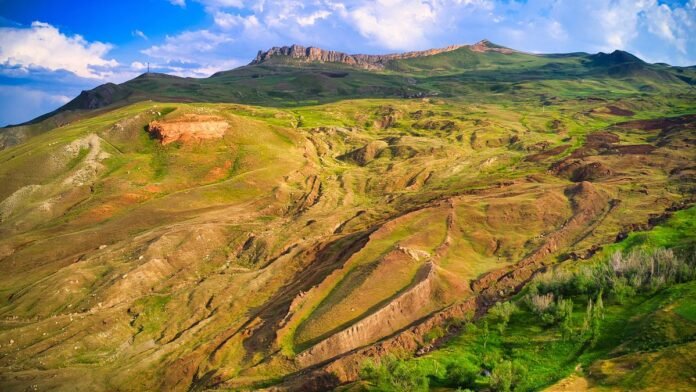

A significant discovery in archaeology has provided strong evidence supporting the existence of Noah’s Ark. Recent studies conducted at the Durupınar geological site in eastern Turkey, a mound shaped like a boat that has long been associated with the biblical vessel, indicate that ancient human activity occurred at the location approximately 5,000 years ago.
According to biblical accounts, Noah was instructed by God to build a massive ark to shelter pairs of every animal species and ensure their survival during the Great Flood. Recently, a team of researchers from Istanbul Technical University and Agri Ibrahim Cecen University (AICU) announced the uncovering of clay materials and marine remnants within the mound’s soil.
Analysis of rock and soil samples revealed the presence of “polygenic” clay materials, a complex combination of clay, silt, and sand that appears to be of human origin rather than naturally occurring, as explained by Professor Faruk Kaya from AICU. The discovery of ceramic fragments suggests human occupation in the area, unique to this specific site.
Professor Kaya emphasized the importance of protecting the Durupınar site to prevent disturbance by visitors and unauthorized removal of artifacts. The researchers also identified traces of marine life, indicating the existence of a vessel or human settlement dating back to the Chalcolithic period around 3000 BC, a timeframe corresponding to the traditional accounts of the Great Flood.
Describing this period as aligning with the era of Prophet Noah, the professor highlighted the historical significance of the findings. The Durupınar site, measuring 157 meters in length and initially unearthed in 1959, has been a subject of contentious debate for decades.
While some argue that its dimensions match the description of Noah’s Ark in Genesis, geologists generally attribute the site’s formation to a natural geological process. In a 1996 research paper, Lorence Collins from California State University refuted claims linking limestone deposits at the site to the Great Flood, presenting evidence that contradicted the notion of the mound being the remains of the biblical ark.
Collins suggested that proponents of the theory may have overlooked substantial evidence to support their claims, emphasizing the need for caution in interpreting such archaeological discoveries.