
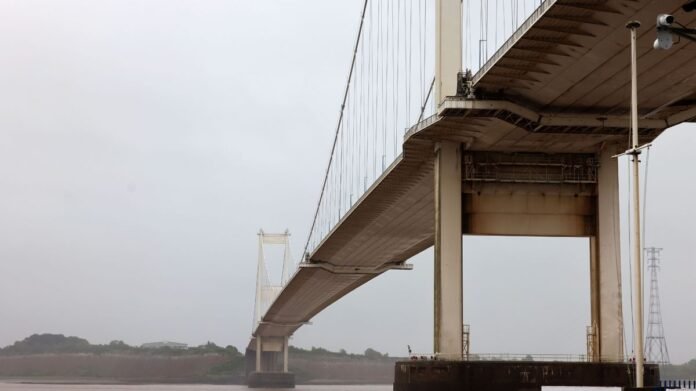

Severe winds from Storm Chandra have forced the closure of a crucial bridge, leading to extensive traffic disruptions in the South West region.
The Severn Bridge, a key route used by over 32,000 vehicles daily, was shut down early this morning, compelling traffic traveling between England and Wales to take an alternate route via the M4 Prince of Wales Bridge. National Highways confirmed the bridge closure and stated, “The M48 Severn Crossing is closed in both directions between J2 (Chepstow) and J1 (Aust) due to high wind speeds.”
As Storm Chandra continues to impact various parts of Britain, National Highways emphasized that wind speeds are under constant monitoring. They explained that traffic destined for the Severn Bridge is being redirected to the M4 Prince of Wales bridge instead. National Highways highlighted the reasons behind the frequent closure of the Severn Bridge during severe weather conditions compared to the M4 Prince of Wales bridge.
A spokesperson from National Highways emphasized safety as their top priority for both the public and their staff. They explained that during windy conditions, the Severn Estuary can channel strong gusts across the bridges, posing risks to traffic. Consequently, access to the Severn Bridge is restricted for the safety of road users, with traffic diverted to the M4 Prince of Wales Bridge, which is equipped with barriers to mitigate wind effects absent on the older M48 Severn Bridge.
The spokesperson further stated, “When wind gusts are expected to exceed 40 knots (46 miles per hour), the M48 Severn Bridge is closed until wind speeds decrease. If wind speeds surpass 70 knots (80mph), both bridges are shut down. Alternative routes between England and Wales involve using the M5, M50, A40, and A449.”
In addition to the Severn Bridge closure, Storm Chandra has caused several other road closures, as reported by Gloucestershire Live. Heavy rainfall has led to saturated grounds and subsequent flooding in areas including Dorset, Somerset, and east Devon. Major roads currently closed due to flooding include the A30 in East Devon, the A303 at the Somerset/Devon border, and the A35 in Dorset.
The Humber Bridge in East Yorkshire has restricted access for high-sided vehicles, and National Rail has cautioned about potential disruptions to South Western Railway services due to adverse weather conditions.
Early on Tuesday morning, a total of 97 flood warnings were issued across England, predominantly in the South West, with additional flood alerts for Wales and parts of Scotland. The Met Office had previously warned of Storm Chandra’s severe weather impact, following closely after Storm Ingrid. South-west England currently faces three warnings, including an amber warning for rain and flooding, and yellow warnings for rain and wind.
Amber warnings have also been issued in south-west England due to heavy rain, and along the eastern coast of Northern Ireland for strong winds. The Met Office anticipates gusts of 60–70mph in those regions, with coastal areas possibly experiencing winds up to 75mph, describing the easterly winds as “unusual and likely to have a significant impact.”
Forecasters have advised residents to remain vigilant as the amber and yellow warnings persist for south Devon, much of Dorset, southern Somerset, and south-east Cornwall until 9am on Tuesday. The yellow warning for rain expires at 10am Tuesday, while the yellow warning for wind ends at 4pm Tuesday.
Paul Gundersen, Chief Forecaster at the Met Office, warned that initial strong winds are expected to affect specific regions before heavy rain exacerbates flooding concerns in Dorset and parts of Devon, Somerset, and Cornwall. As Storm Chandra interacts with colder air further north, snow accumulation of 10–20cm is likely over higher ground in the Pennines, southern Scotland, and the Highlands. The public is advised to stay updated on weather forecasts and warnings in their respective areas due to the complex weather patterns.