
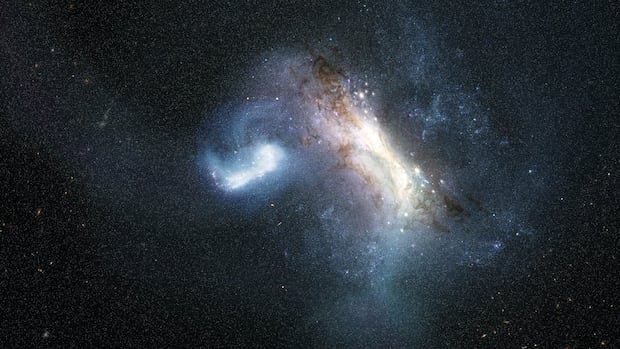

A recent study highlights a significant event in the history of the Milky Way galaxy, shedding light on its growth and evolution. Approximately 11.8 billion years ago, when the universe was still young, the Milky Way absorbed a smaller galaxy, marking its earliest galactic merger. This merger, involving a dwarf galaxy known as Low-energy-Kraken-Heracles (LKH), added stars and interstellar gas to the Milky Way, fueling star formation and contributing to the galaxy’s development.
Researchers utilized the Hubble and Gaia telescopes to examine stellar clusters near the Milky Way’s core, revealing insights into the merger. The LKH galaxy, with stars equivalent to 500 million solar masses at the time of the merger, played a crucial role in shaping the Milky Way’s structure. The merger, occurring approximately two billion years after the Big Bang, brought new stars and materials to the Milky Way, including dark matter.
Astrophysicist Davide Massari, the lead author of the study published in Nature Astronomy, emphasized the importance of this discovery, calling it the first merger event experienced by the Milky Way in its early stages. The study suggests that the merger process was relatively peaceful for stars but more dynamic for gas, triggering intense star formation.
The Milky Way has a history of galactic mergers, having previously absorbed the Gaia-Sausage-Enceladus dwarf galaxy and interacted with the Sagittarius dwarf galaxy. Each merger has influenced the formation of our solar system and Earth. By unraveling the Milky Way’s past, researchers aim to address fundamental questions about our origins.
This research offers valuable insights into the Milky Way’s evolution and highlights the role of galactic mergers in shaping our cosmic environment.