
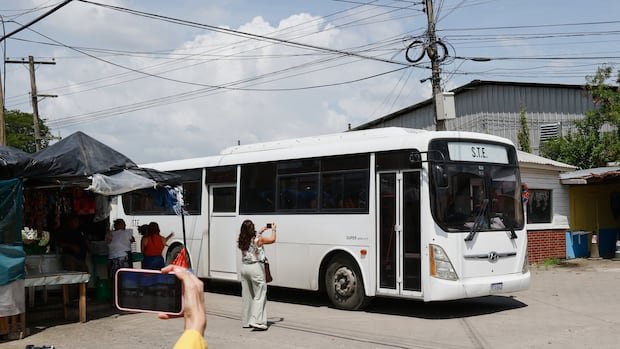

The United States has deported close to 2,300 Mexicans to Guatemala this year and also sent several individuals to Honduras, as per official records, marking a change from the early part of U.S. President Donald Trump’s second term when such actions were scarce.
Previously, only a few Mexicans were expelled to countries other than Mexico, in line with the principle of non-refoulement in U.S. immigration law and international agreements. This principle prohibits sending migrants back to countries where their rights, safety, or freedom might be at risk due to factors like race, religion, or nationality.
Mexico’s National Migration Institute (INM) verified to The Associated Press that Mexicans have been deported to Guatemala and Honduras by the Trump administration, particularly since April, and are then transferred by bus to southern Mexico.
In response to this practice, the Mexican Foreign Ministry stated that it has objected to the deportations to U.S. authorities and reiterated that every Mexican citizen has the right to enter the U.S.
The movement of migrants through Mexico and across the U.S. border has often caused tensions between the two nations. During the second term of President Trump, the Mexican government has also raised concerns about the deaths of 17 Mexicans in U.S. immigration custody or enforcement actions.
The U.S. Department of Homeland Security, responsible for immigration enforcement, explained that the deportations to Central America are part of the administration’s efforts to conduct significant deportation operations, in line with President Trump’s commitments.
Guatemalan President Bernardo Arévalo disclosed that 2,284 Mexicans deported from the U.S. have transited through Guatemala before being returned to Mexico under an agreement with the Mexican government. Similarly, 82 Mexicans arrived in Honduras on flights in August, with more arrivals later.
Immigration lawyers believe that the U.S. administration is using deportations to third countries as a legal tactic to indirectly pressure asylum seekers to return to Mexico when direct deportation is not feasible due to court orders acknowledging risks. This strategy aims to compel the Mexican government to take action to curb border crossings.
At the start of Trump’s second term, agreements were reached with several countries, including Mexico, to serve as transit or destination points for migrants expelled from the U.S. to third countries.
In a separate development, the U.S. deported individuals to Haiti and Liberia for the first time following legal battles at the Supreme Court. The Supreme Court ruling allowed the Trump administration to terminate the temporary protected status (TPS) program for Haitians and Syrians, affecting residents from various countries who received TPS protections.
Haiti’s National Office of Migration reported the arrival of deportees, some of whom were of Haitian descent but not necessarily born in Haiti, after living in the U.S. under TPS since the 2010 earthquake.
Activists have raised concerns about the safety and resources in Haiti for deported individuals, given the ongoing violence and humanitarian challenges. In Liberia, deportees from various regions arrived and could seek asylum in the country if desired.
The U.S. State Department emphasized its commitment to addressing illegal immigration and strengthening border security.