
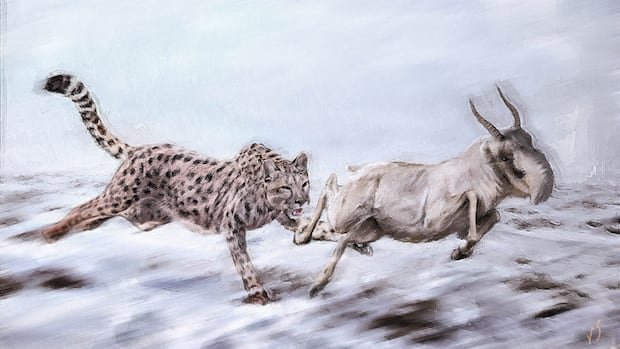

A recent discovery in northern Yukon has upended previous assumptions about the origin of bones found in the Bluefish Caves and a local mine site. Initially believed to belong to an ice-age puma or cougar, DNA analysis conducted by Molly Cassatt-Johnstone from the University of California revealed a surprising twist. Cassatt-Johnstone, a lab technician fresh out of undergrad at the time, recalled her initial shock when the results indicated that the bones were not from pumas but rather cheetahs.
Yukon paleontologist Grant Zazula vividly remembers the moment he received the unexpected news that the presumed cougars were actually cheetahs. The revelation marked a significant milestone in the study of ancient DNA, a field that was once considered akin to science fiction but has now become a routine practice in analyzing permafrost-preserved remains from the region.
Cassatt-Johnstone’s groundbreaking identification of the Yukon Miracinonyx, also known as the extinct American cheetah, led to her authorship of a paper published in Current Biology. This study sheds new light on the ice-age cat’s dietary habits and territorial range, providing valuable insights into its ecological niche.
Researchers had long believed that the American cheetah, resembling modern cheetahs in physique, specialized in hunting pronghorns across grassy plains. The unexpected discovery of these cheetahs in the Arctic tundra challenged existing theories, as the absence of pronghorns in the Beringia region raised questions about the species’ survival strategies in a unique environment.
To unravel this mystery, a team of researchers from Canada and the U.S. conducted stable isotope analysis on bone samples from the cheetahs. This forensic technique, akin to solving a complex puzzle, revealed that the Yukon cheetahs had primarily subsisted on fish—an unusual dietary behavior for both past and present-day felines. The findings underscore the interconnectedness of ecosystems and the adaptive strategies employed by ancient predators in response to environmental challenges.
The study’s comprehensive genetic analysis indicated that Miracinonyx was more closely related to North American pumas than African cheetahs. Moreover, the researchers identified low genetic diversity and population numbers, suggesting a potential factor in the species’ eventual extinction. Yukon paleontologist Grant Zazula proposed renaming this distinct northern population from ‘American Cheetah’ to ‘Yukon Cheetah,’ underscoring the ongoing surprises and revelations that paleontology continues to uncover in the region.