
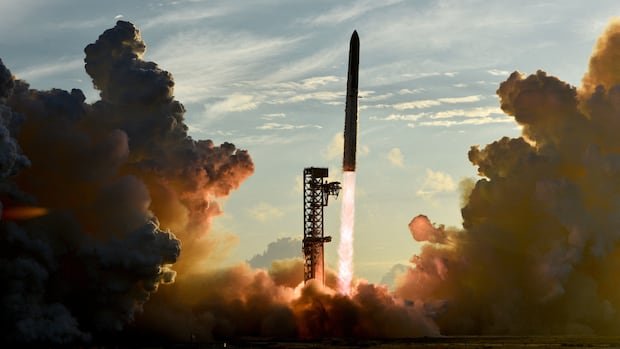

SpaceX conducted the inaugural orbital launch of its massive Starship on Monday, successfully deploying the most advanced Starlink satellites to date before cutting the mission short, with the spacecraft splashing down in the Pacific Ocean after over three hours. Originally targeting a 10-hour flight encompassing six orbits around Earth to demonstrate readiness for NASA’s Artemis moon program, the mission faced an initial setback when one of the engines shut down prematurely post-launch. Despite this, flight controllers opted to proceed as all systems were operational and the malfunctioning engine was deemed unnecessary.
The Starship, a flagship rocket by Elon Musk, carried 26 cutting-edge Starlink satellites to augment the existing fleet of 11,000, providing internet services. The satellites were systematically released from the spacecraft to the delight of onlookers at the Starbase launch site in Texas. Following the successful deployment, the decision was made to end the mission early, although no specific reason was provided.
This marked Starship’s 14th launch from Texas in three years, a significant advancement from previous test flights that had limited range. Despite achieving the desired orbit height of 275 kilometers and maintaining the intended speed, a cautious approach led flight controllers to curtail the mission after completing a few laps. The booster stage was not recovered at the launch site, as it descended into the Gulf of Mexico shortly after liftoff.
SpaceX’s priority remains safety and successful recovery of the spacecraft, with plans to utilize mechanical arms for in-flight capture in subsequent missions. The aim is to ensure a reusable design to reduce launch costs, with lessons learned from previous missions guiding modifications and future operations.
As SpaceX works towards certifying Starship for orbital flights, upcoming missions like Artemis III hold promise for moon and Mars exploration. Collaborative efforts with NASA and private entities like Blue Origin underscore the potential for commercial space travel and exploration. Musk’s vision for Starship extends beyond Earth’s orbit, with ambitions for future Mars missions and satellite deployment to drive innovation and space exploration.