
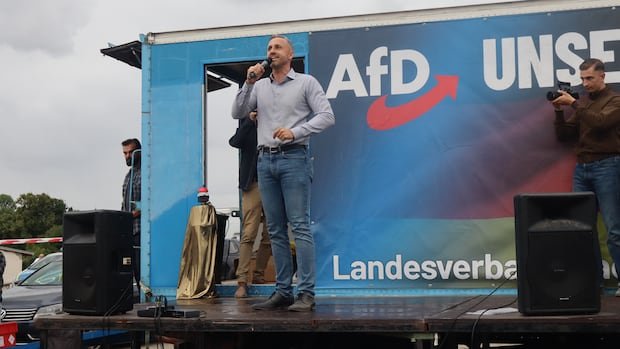

On a sunny August day in the peaceful town of Quedlinburg in eastern Germany, a large crowd gathered to listen to a prominent far-right leader’s vision for the future of the country. Many arrived on their Simson motorcycles, which have become a symbol associated with the Alternative for Germany (AfD) party, to meet Ulrich Siegmund, the AfD’s candidate for the leadership of the eastern state of Saxony-Anhalt.
The AfD is experiencing a surge in support according to opinion polls, and in an upcoming regional election, it could potentially become the first far-right party to attain state power in Germany since World War II. Analysts suggest that the AfD could wield significant influence over state resources, especially in areas such as education. The party aims to implement initiatives like segregating classrooms for refugees, fostering ties with Russia through student exchange programs, and emphasizing a patriotic agenda that shifts focus away from the nation’s Nazi history.
“I believe [Siegmund] speaks sincerely, from our hearts,” remarked 17-year-old Luca Stemmler during the Quedlinburg gathering, describing Siegmund as an inspiration.
Opposite the motorcycle rally, counter-protesters displayed rainbow flags and sang The Beatles’ “All You Need Is Love,” demonstrating solidarity against a party that some fear might challenge fundamental human rights and alter key aspects of Germany’s postwar democratic framework.
The AfD’s rise to power hinges on the reluctance of mainstream political parties to collaborate with extremist groups, a strategy known as “the firewall” aimed at safeguarding Germany’s democracy. If current opinion polls materialize into votes, the AfD could potentially secure a foothold in the state government, despite efforts by other parties to prevent this outcome.
In Saxony-Anhalt, the AfD leads in opinion polls with 42%, as reported by German election research company Infratest-Dimap. The party also commands a national polling advantage at 28% and secured substantial seats in the 2025 federal election.
Originally established in 2013 as an anti-Euro party, the AfD shifted its focus to migration issues in 2015 following Chancellor Angela Merkel’s acceptance of a large number of refugees from countries like Syria.
The AfD’s policy objectives include advocating for “remigration,” a term often used in right-wing circles to describe mass deportations of individuals with a migration background. Additionally, the party in Saxony-Anhalt promises to restrict immigration from non-European Union countries deemed problematic, establish numerous detention centers for deportees, and create separate classrooms for refugee children.
Akinola Sanyaolu, a Nigerian immigrant residing in Magdeburg, Saxony-Anhalt’s capital city, expressed experiencing racism in the city due to the perception that immigrants are to blame for political and economic challenges in the country. Despite facing hostility, Sanyaolu remains hopeful about his future in Germany.
The AfD’s government manifesto in Saxony-Anhalt outlines specific objectives, including prohibiting Pride flags in schools, revising history curricula to emphasize positive aspects of Germany’s past, and defining a “healthy family” as a household comprising a father, mother, and children.
If the AfD assumes power in Saxony-Anhalt, it could potentially influence state-level intelligence services, raising concerns due to the party’s ties to Russia. Party members have reportedly praised and visited Russia, highlighting a strong interest in fostering economic and cultural relations with the country.
Days before the motorcycle rally, hundreds of AfD supporters gathered in Querfurt, where many queued to obtain T-shirts featuring Siegmund’s image. The charismatic 35-year-old, with a significant TikTok following, emphasized unity and support among his followers during the festival.
The AfD’s popularity stems from a variety of factors, including dissatisfaction with mainstream political parties, concerns about political uncertainty driven by global events, and regional disparities between eastern and western Germany, where AfD support is notably strong.
In the event of an AfD victory, the party’s influence could extend to the federal level through representation in the Bundesrat, potentially disrupting legislative processes. Despite constitutional safeguards, winning a state election would further legitimize the AfD as a significant political force.
Concerns also exist that an AfD triumph could bolster the party’s position on the national stage, with implications for Germany’s democratic norms. The party’s ability to adapt to different outcomes may enhance its narrative and strengthen its appeal among disillusioned voters.
The reporting on this story received partial funding from the Gordon Sinclair Roving Reporter Bursary.