
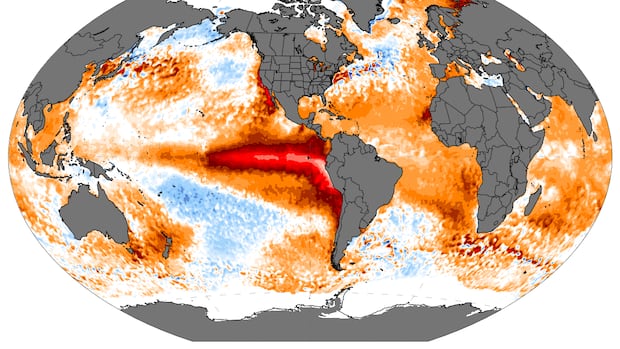

Researchers from Ocean Networks Canada have detected unprecedented water temperatures off the coast of British Columbia this month, indicating the onset of an El Niño phenomenon compounded by ongoing climate change.
The initiative, part of the University of Victoria, manages two underwater observatories connected by cables to various research locations. One of these, situated off the west coast of Vancouver Island, recorded a temperature of 8.21°C at a depth of 400 meters on November 8.
This measurement at the Barkley Canyon Upper Slope was 2.49°C above the long-term average for that site, where observations have been ongoing since 2009, and surpassed the previous record from 2019 by 0.89°C, according to a statement released by the organization on Tuesday.
El Niño occurs due to a shift or weakening of the winds that typically drive warm water towards the western Pacific near Australia and Asia, as explained by Jay Cullen, an oceanographer and the interim president of Ocean Networks Canada.
He elaborated that during an El Niño event, warm water “sloshes back” eastward and disperses upon reaching the western coasts of North and South America.
“For British Columbia, this warm water travels as a confined wave along the shoreline,” Cullen noted, adding that it also modifies atmospheric circulation, which could lead to increased rainfall and reduced snowfall in coastal regions this winter.
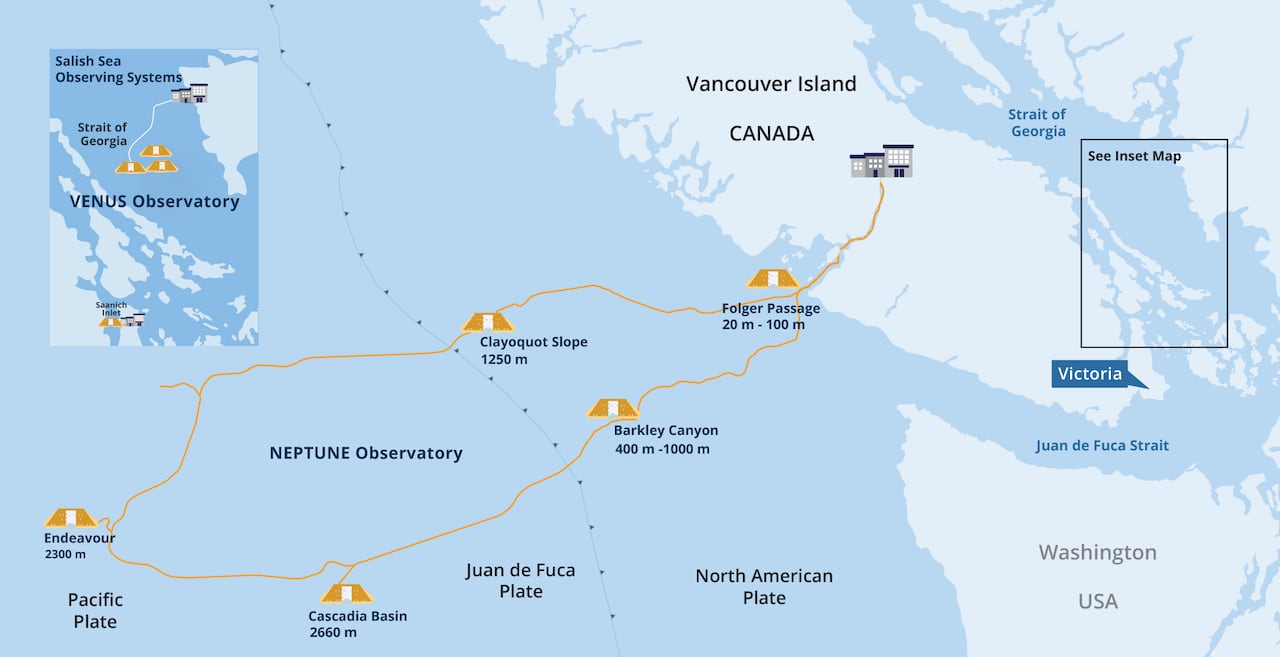
This graphic, provided by Ocean Networks Canada, illustrates the locations of ocean research sites. (Handout by Ocean Networks Canada/The Canadian Press)
While El Niño is a natural occurrence, it is unfolding against a backdrop of long-term global warming that is already putting stress on ecosystems and species, Cullen remarked.
Increased water temperatures lead to lower oxygen levels in regions that support fisheries for salmon and herring, as well as habitats for iconic species like the endangered southern resident killer whales in the Salish Sea, he stated.
The region also experiences economic activities, such as the expansion proposal at the Port of Vancouver’s Roberts Bank facility, which has received support from Ottawa.
“Growing shipping and economic development along our coastline must be accompanied by diligent monitoring and environmental stewardship,” Cullen emphasized.

Jay Cullen, interim president and CEO of Ocean Networks Canada, warned that elevated ocean temperatures could affect vulnerable species. (Handout by Ocean Networks Canada/The Canadian Press)
Cullen expressed concern over the elevated temperatures at greater ocean depths, as many organisms inhabit or retreat to these cooler areas.
“If the warming related to El Niño extends beyond the surface and reaches considerable depths, it places additional stress on the ecosystem,” he remarked.
El Niño also results in rising sea levels, increasing the likelihood of coastal flooding.
“We are seeing an increase of approximately 15 centimeters in sea level,” Cullen noted.
“With winter storms and king tides, the risk of coastal flooding is heightened, particularly with current sea levels already warmer and higher than historical averages.”
-
Meteorologists are forecasting a ‘super’ El Niño. What does that mean for B.C.?
-
What does a super El Niño mean for the Vancouver Island snowpack?
A graph shared by Cullen’s team illustrated a significant rise in the daily average temperature at the Barkley site, beginning in late October.
Cullen indicated that this reflects the movement of warm water from the equatorial Pacific towards the coast of B.C., although calmer winds have also contributed by diminishing the “upwelling” of cooler water from below.
“Recently, those upwelling winds have eased, which has made the arrival of that warm water more pronounced,” he explained.
The Clayoquot Slope, located over 1,200 meters below the surface, has also been registering “significantly” above-average temperatures, according to Cullen’s team.
Conversely, the Cascadia basin, the deepest of the monitored sites at 2,650 meters, remains within its normal temperature range.
Cullen noted that the El Niño phenomenon is expected to peak in early next year and will likely “ease” as spring approaches.
He added that Ocean Networks Canada is collaborating with the Fisheries Department to keep track of the El Niño and its impacts along the coast of B.C.
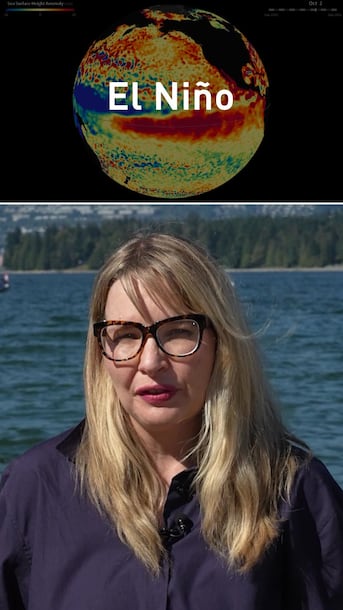
Regarding El Niño’s broader implications across Canada, Bill Merryfield, a research scientist with Environment and Climate Change Canada, previously mentioned to CBC News that the effects typically do not manifest until late December.
“These impacts usually intensify as winter progresses,” he stated.
Merryfield added that an elevated likelihood of warmer winter conditions due to El Niño could lead to a reduced snowpack on the West Coast.
Tag: rewrite-pending