

Anthropic is poised for a significant stock market entry—bringing with it a substantial valuation, extensive expenditures, serious warnings, considerable uncertainty for investors, and a major potential signal of the artificial intelligence sector’s trajectory through 2027.
In a revised U.S. regulatory submission on Tuesday, Anthropic, headquartered in San Francisco, indicated an anticipated initial public offering (IPO) price range between $70 and $78 US per share. This suggests a fully diluted market valuation of about $1.3 trillion US at the midpoint, escalating to $1.4 trillion US at the highest end, representing the largest technology stock market launch in history.
Greg Taylor, a portfolio manager at PenderFund Capital Management in Vancouver, remarked, “This is set to be among the largest IPOs ever.”
The magnitude of an IPO is generally assessed based on the capital raised. Anthropic aims to secure up to $64.4 billion US via its public share offering. If successful, it will trail only SpaceX’s record-breaking stock market debut in June.
The company is anticipated to commence trading on the Nasdaq exchange next week, with a listing notice indicating its launch on Nov. 19. Nevertheless, the specific date has yet to be confirmed in its filings with the U.S. Securities and Exchange Commission (SEC).
Ernest Wong, the head of research at Baskin Wealth Management in Toronto, predicts that when the stock commences trading on Nasdaq, it will be a formidable contender.
“Only a select few stocks globally are valued above $1 trillion US,” he noted. “This illustrates the magnitude of AI’s impact.”
What is Anthropic?
Founded in 2021, Anthropic originated as a specialized AI research facility when its creators departed from OpenAI, citing concerns over its profit-driven focus that neglected risks and granted excessive authority to investors.
The company gained traction in 2024 with the launch of Claude 3.5 Sonnet, which surpassed OpenAI’s GPT-4o on key performance metrics, all while being significantly less costly than prior advanced AI models.
-
OpenAI scraps release of new AI model over safety concerns
-
BMO, CIBC, RBC, TD Bank block personal AI agents, citing safety and security
-
FRONT BURNER
Will Anthropic’s IPO go boom or bust?
Differing from traditional for-profit corporations like Apple or Microsoft, Anthropic is structured as a public benefit corporation, which legally obligates its board to weigh public safety against maximizing returns for shareholders.
Currently, Anthropic’s CEO Dario Amodei is a prominent advocate for AI safety, contending that the sector should decelerate its progress to allow safety protocols to catch up.
In its latest regulatory documentation to the U.S. Securities and Exchange Commission, Anthropic dedicated 94 of over 300 pages to outlining an extensive array of risk factors.
The company indicated, “Our AI models may act in unintended, misaligned, or autonomous manners, potentially undertaking harmful actions that were not directed by any user or third party.”
Anthropic further cautioned that such behavior could involve “actions akin to blackmail or attempts to sway human decision-makers to ensure the model’s continuous operation,” alongside risks that “pose catastrophic or existential threats to humanity.”
Big numbers
$1.4 trillion US is not the sole striking figure associated with Anthropic’s IPO.
The company’s valuation has shown considerable volatility in recent months, with $2 trillion US recently being considered. As of late May, private investors estimated the company’s worth at $965 billion US, a significant rise from $380 billion US in February.
Taylor commented, “There’s a substantial level of optimism embedded in these valuations as they emerge.”
“No one can accurately predict what Anthropic will look like five years from now,” he added.
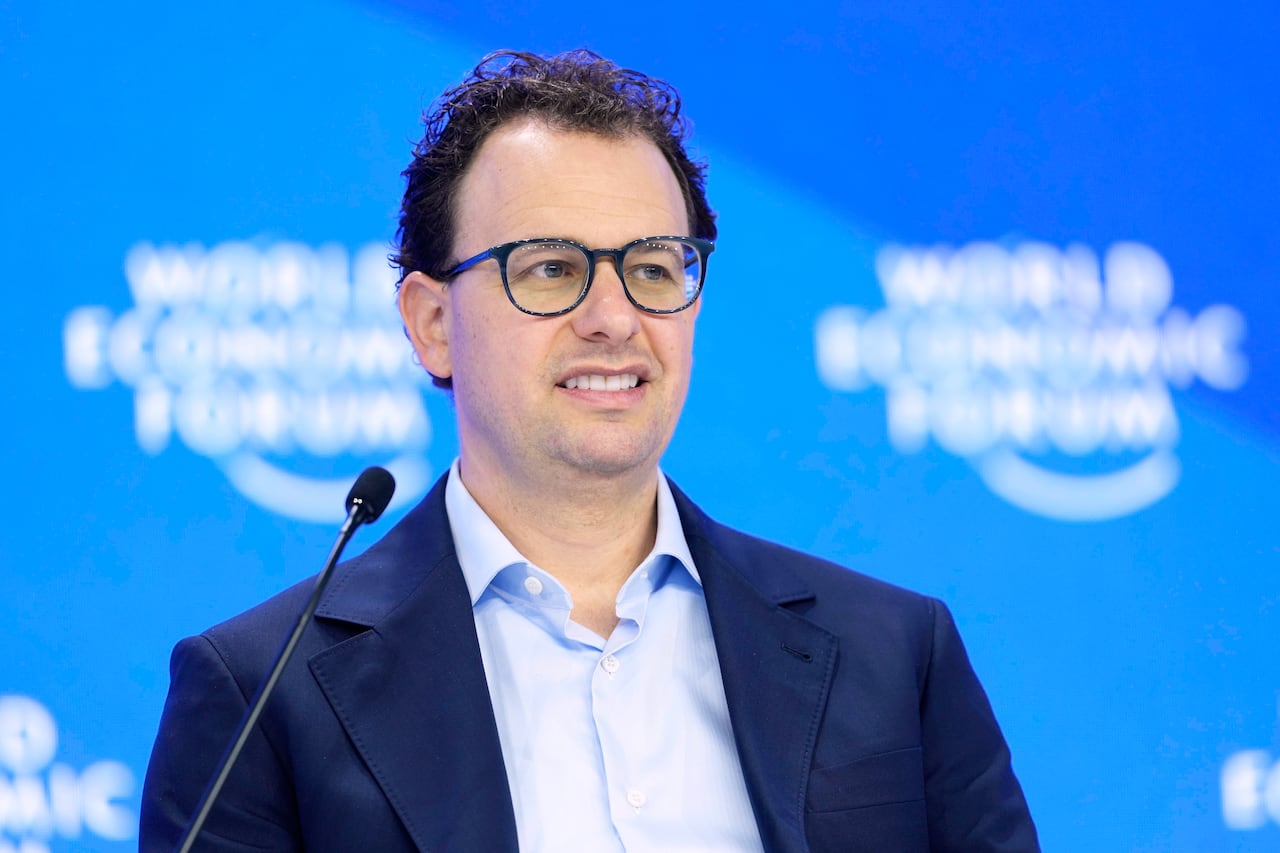
Dario Amodei, CEO and co-founder of Anthropic, attends the annual meeting of the World Economic Forum in Davos, Switzerland, in January 2025. (Markus Schreiber/The Associated Press)
The company has seen robust sales. Regulatory filings reveal that Anthropic generated over three and a half times the revenue in the first half of 2026 compared to the entire previous calendar year. Approximately 20 percent of these earnings originated from two large unnamed clients.
Concurrently, the AI powerhouse has incurred significant losses. Through June, it reported a net loss of $80.7 billion US this year, primarily due to non-cash accounting charges. The previous year, the company recorded a loss of $42 billion US in 2025.
Anthropic also has ambitious spending strategies. The firm does not construct or own any data centers; instead, it leases high-performance computing resources from cloud service providers like Amazon Web Services and Google Cloud via extensive multi-year service agreements.
As per regulatory filings, Anthropic has committed nearly $900 billion US in cloud and computing contracts that extend well into the 2030s and 2040s. Its partners in these arrangements include Broadcom, SpaceX AI, Google Cloud, Amazon Web Services, and Microsoft Azure.
A blockbuster IPO
Anthropic’s IPO is notable not only for its immense size.
Taylor remarked, “Investing in the Anthropic IPO represents one of the first pure play AI opportunities available.”
So far, investors wanting to engage in the artificial intelligence surge have primarily been restricted to less AI-centric technology stocks like Microsoft or Nvidia, known for chip production. While Google is regarded as part of the AI investment narrative, its extensive businesses extend beyond AI, including Android smartphones and YouTube.
Wong stated, “Anthropic’s sole focus is on developing new AI models. It fills a significant gap in the market, as public company data has been available for various AI industry players, except for model companies, primarily Anthropic and OpenAI.”
Should Anthropic’s IPO be perceived as a new standard for AI investments, its initial trading days will unfold amidst considerable volatility in the technology market.
Tech and AI stocks faced sharp declines and rapid recoveries earlier this month, as markets entered a corrective phase. This was fueled in part by worries about AI firms balancing their substantial expenditures with adequate profits. Political uncertainties in the U.S. following the midterm elections regarding stricter regulations for AI and data centers further complicated matters.
Moreover, the recent controversy involving Nvidia’s CEO Jensen Huang’s alleged connection with a suspected Chinese spy adds another layer of concern for AI investors. The chipmaker’s stock, regarded as a bellwether for AI investments, has lost billions in market value recently on Nasdaq, where Anthropic is set to launch.
Like the dot com bubble?
Wong pointed out that “the primary risk for Anthropic lies in its need to compete with other model developers. The competition is fierce.” He noted that OpenAI creates its own models, while SpaceX, through Grok, leads in model development, with Google and Meta also vying for dominance in this arena.
He anticipates that the stock will be challenging for cautious investors initially, as they will compare each new Anthropic product against competitors and scrutinize its substantial spending on data services.
“It will be highly volatile,” Wong warned.
This mirrors the experience of SpaceX since its Nasdaq debut in June, where the stock initially surged by approximately 19 percent on the first day, only to subsequently drop as much as 22 percent below its $135 US IPO price.
Taylor believes that the substantial expenditures in the AI sector, rapid stock increases, and the interconnected nature of a few tech companies serve as reminders of a prior investment frenzy that distinguished winners from losers in dramatic ways.
“The dot-com bubble likely resonates strongly in many minds,” he said. “In 2000, there was a fervent desire to invest in the internet.”
While entities like Pets.com collapsed, Google and Microsoft emerged as household names.
“There are significant parallels here with AI,” Taylor remarked. “The challenge lies in determining which companies will ultimately prevail.”