
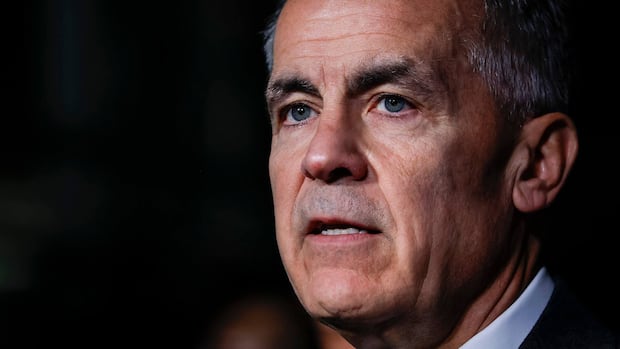

On Tuesday, Prime Minister Mark Carney referred to Stellantis’ confirmed decision to sell its automotive assembly facility in Brampton, Ontario, as “a betrayal” of the global automaker’s “responsibilities to Canada and, by extension, to all Canadians.”
However, a previously acquired version of the multi-million-dollar funding agreement between Stellantis and the federal government indicates that the automaker had an escape route regarding the closure of the Brampton plant.
The 2022 agreement, which CBC News obtained earlier this year, is partially obscured, meaning not all conditions can be seen.
-
Video
Industry minister states Stellantis has chosen to ‘violate its contract’
-
Video
Carney labels Stellantis plant sale ‘unacceptable,’ Poilievre urges Joly’s dismissal
Nonetheless, a clause added to the agreement in 2023 specifically states that shutting down the Brampton plant before 2035 would breach the contract if factors beyond the automaker’s “reasonable control” rendered the facility “commercially unviable,” and Stellantis could not provide “substantial evidence” that it had made all reasonable commercial efforts to secure alternative mandates for Brampton.
In simpler terms, if Stellantis could demonstrate “substantial evidence” of attempts to explore other options for Brampton, it may not be considered in violation of the agreement, under which the company has received at least $220 million in federal funding for its operations in Brampton and Windsor, Ontario.

The Brampton Assembly Plant, in Brampton, Ont., is depicted on Oct. 15, 2025 — the date Stellantis revealed it would relocate vehicle production to the U.S. (Evan Mitsui/CBC)
The specific wording regarding Stellantis’ commitments to Ottawa has resurfaced in political discussions following the announcement on Monday, when the automaker disclosed plans to transfer the Brampton plant to defense contractor Roshel.
Windsor West MP Harb Gill, who is the Conservative shadow minister overseeing the auto sector, stated that the terms in the agreement regarding factors outside Stellantis’ “reasonable control” require greater clarity.
“Clearly, Stellantis will assert it was the tariffs or the trade conflict and similar issues,” Gill remarked on Tuesday. “But what kind of proof or evidence did the government request in return to justify why this is not commercially viable? Explain how it’s not feasible when you’re still producing or merely shifting production from Canada to the U.S. while selling the same product.”

Harb Gill, the Conservative MP for Windsor West, pictured in Windsor, Ont., in July 2026. (Samantha Craggs/CBC)
The federal government did not respond on Tuesday to inquiries regarding why it accepted that language or whether Stellantis has claimed that tariffs have rendered the plant commercially unviable.
For its part, Stellantis stated that the company is “not commenting on specific legal interpretations or discussions with the government while those matters are being resolved.” A spokesperson also pointed out that the sale of the plant to defense contractor Roshel is not finalized; instead, the parties have entered into an asset purchase agreement, “a step toward the proposed transaction.”
Last year, Stellantis announced it would relocate the planned production of the Jeep Compass from Brampton to Belvedere, Illinois, triggering a political uproar regarding the public funding the company has received.
In December, Industry Minister Mélanie Joly announced that the federal government would issue a notice of default to Stellantis under its contracts with Ottawa.
Additionally, Stellantis was involved in funding agreements worth billions related to the NextStar Energy battery plant in Windsor, which was formerly a joint venture between the automaker and LG Energy Solution. However, Stellantis divested its stake in the project earlier this year.
The current status of the formal contractual dispute regarding Brampton remains unclear. When asked about it on Tuesday, a spokesperson for the federal industry department stated that for “over a year, [the] government and Unifor have engaged in good faith efforts to reach a resolution, yet Stellantis has once again opted to violate the commitments it made.
“This directly betrays Brampton workers and the obligations to Canadians,” the spokesperson continued.
“As the Prime Minister has emphasized, our government will utilize every available tool and the full extent of the law to uphold our rights, protect Canadian taxpayer dollars, and advocate for justice and jobs for these workers.”
A source familiar with the sale of the Stellantis Brampton plant revealed that the federal government has been in regular discussions about the deal since August. The source indicated that both the Prime Minister’s Office and Industry Minister Melanie Joly’s office have been briefed on the details of the upcoming announcement. CTV News initially reported on the government’s involvement in the negotiations, citing three anonymous sources.

Stellantis’s decision to sell its Brampton, Ont., auto assembly plant to defence vehicle manufacturer Roshel has sparked immediate political fallout, with Conservative Leader Pierre Poilievre calling for Industry Minister Mélanie Joly to be fired even as the company repays its federal funding. Power & Politics speaks with Kyle Seeback, the Conservative Party’s labour critic.
In a statement released on Monday confirming the purchase agreement, Stellantis CEO Antonio Filosa mentioned that the automaker is “creating new opportunities for Stellantis in the defense sector and is paving the way for the Brampton facility to be returned to productive industrial use.”
This announcement has triggered criticism from opposition MPs and Unifor, the union representing more than 2,000 unionized employees at the Brampton plant who have been laid off since 2023.
Stellantis stated on Tuesday that it understands “that Canadians expect accountability for public funds” and that the company “has proposed to voluntarily return the government support received for the original retooling initiative of the Brampton Assembly.”
-
Stellantis auto plant sale elicits optimism, pain in Brampton, Ont., after 2,000 job losses
-
Brampton plant sale leaves Stellantis workers in Windsor questioning their own job security
However, the company did not disclose the amount of funding it intends to return or the timeline, citing confidentiality clauses in the agreements.
The industry department announced that Joly “will hold a meeting in Toronto” on Thursday with Stellantis executives, Unifor National President Lana Payne, and provincial representatives.
Payne’s office declined an interview request on Tuesday, but informed CBC’s Power and Politics that the government still possesses options to stop the sale of the Brampton plant, and determining the sale’s conditions will be crucial.
“All we needed was for the government to maintain their stance,” Payne asserted, as her union has reached an impasse with Stellantis in its latest collective bargaining efforts. “We’ve already seen the conditions for this trade conflict shift in the U.S.”
Gill, for his part, indicated that Conservatives on the House’s industry committee will seek to investigate the Stellantis situation and will call Joly to testify before the panel soon.