

China has encircled Taiwan with what it terms as a “shield of justice” through extensive military exercises involving the army, navy, and air force around the island nation.
These significant drills coincide with Beijing’s threats to “annihilate” its smaller neighbor amidst escalating tensions in the region. The extensive military maneuvers follow the announcement by the US to sell a substantial £8.2 billion weapons package to Taiwan.
The massive deployment comprises 89 Chinese aircraft, 14 naval vessels, and 14 coast guard ships, along with a fleet of four amphibious assault ships, as reported by Taiwanese military officials. China vehemently opposed the weapons sale, accusing Washington of bolstering its adversaries.
Dubbed “Justice Mission 2025,” the exercise reportedly includes a simulation of an island blockade, forming part of the drills that the People’s Liberation Army (PLA) claims has established a defensive “shield of justice” around Taiwan.
According to PLA disclosures, Taiwan is currently encircled by five blockades, with the exercises scheduled to continue until Tuesday as Beijing conducts comprehensive “multi-dimensional deterrence” training.
The activities will focus on enhancing readiness for maritime and aerial combat patrols, achieving integrated control, and securing crucial ports and areas, stated Shi Yi, a spokesperson for the Eastern Theater Command. The operation aims to serve as a stern warning to forces supporting Taiwan Independence and external interference.
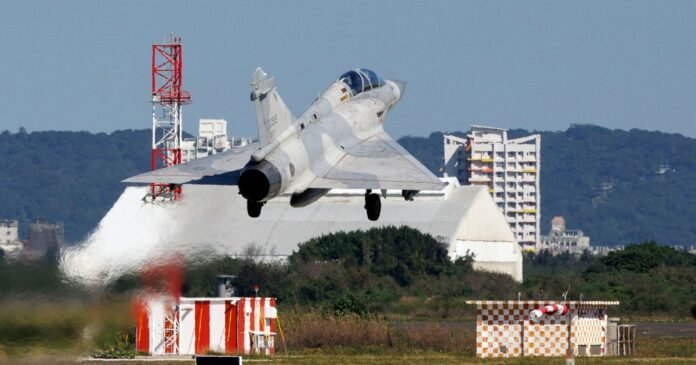
In a chilling statement, it was declared, “All attempts at independence will be eliminated upon encountering the shield!” Meanwhile, in response to the Chinese military display, Taiwan launched fighter jets to patrol its airspace, while its military leadership prepared for drills simulating a response to a potential invasion.
Local reports indicated that the PLA Navy had deployed 14 ships, 14 coast guard vessels, and a fleet of four amphibious assault ships in the Western Pacific, alongside 89 sorties of main and auxiliary aircraft and drones, of which 67 entered Taiwan’s response zone.
Since assuming office in 2024, Taiwan’s President Lai Ching-te has committed to increasing defense spending in light of tensions with Beijing. In October, plans were announced for the construction of an air defense system to counter hostile threats.
The escalating defense spending by Taiwan has irked Beijing, as the island remains a focal point of contention between the US and China. Recent demands by President Donald Trump for Taiwan to allocate around 10 percent of GDP to defense represent a significant increase in funding.
The Trump administration’s new national security strategy calls for greater contributions from US allies in the region for collective defense. The UK faces pressure to align with the US amid concerns over a shift in focus from Europe to the Pacific. The UK maintains a consistent stance on the Taiwan issue, emphasizing that the future status of Taiwan should be determined by its people.
While President Joe Biden had pledged US defense of Taiwan if invaded by China, President Trump has refrained from reiterating such statements. The new national security strategy aims to prevent conflicts by bolstering a military capable of deterring aggression.
Prime Minister Sir Keir Starmer has committed to allocating five percent of GDP to national security by 2035, aligning with Trump’s calls for increased NATO spending on defense. Defence Secretary John Healey announced a projected rise in defense spending to three percent in the upcoming parliamentary term, without specifying the exact fiscal year for this target.