
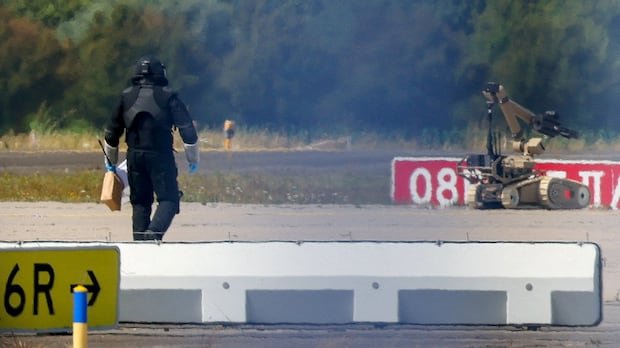

German authorities are currently investigating a drone carrying explosives and a detonator discovered at Leipzig airport. In response, Russian Foreign Minister Sergey Lavrov has indicated that Moscow intends to increase its retaliation against countries supporting Ukraine. Lavrov stated in an interview with VGTRK, Russia’s state media, that they would employ more severe methods to eliminate support for Kyiv’s military efforts.
The drone, containing an unknown explosive device, was found in the security area of the cargo operations zone near the south runway of Leipzig airport, designated as critical infrastructure. Leipzig serves as a key NATO airport facilitating the transport of weaponry, ammunition, and military supplies to Ukraine via flights operated by Ukrainian cargo firms.
The presence of the drone near a Ukrainian cargo plane has raised concerns in Germany, with the country’s interior minister describing it as a heightened level of danger. Alexander Dobrindt emphasized that the incident appears to be part of a sophisticated hybrid threat scenario rather than the work of amateurs.
While German authorities continue their investigation, they have not disclosed the drone’s origin. U.S. intelligence sources have suggested that the drone may be linked to the Russian government. Berlin is taking a cautious approach, enhancing anti-drone capabilities and refraining from premature attributions.
Concerns persist regarding Russia’s use of drones, espionage, sabotage, and influence operations in Europe, particularly in the lead-up to regional elections in Germany. Dobrindt highlighted the evolving threat landscape faced by Germany on a daily basis.
Germany has been a frequent target of hybrid warfare tactics, including espionage, cyber attacks, and covert actions aimed at destabilizing the country and effecting political change. Recent incidents, such as the uncovering of a Russian plot to assassinate a German defense contractor’s CEO and the arrest of a suspected Russian spy, underscore the ongoing security challenges.
The Institute for Strategic Dialogue has identified Russia’s online interference campaign, Operation Overload, focusing on creating discord within NATO member countries and Ukraine. The dissemination of disinformation and impersonation tactics are employed to undermine Ukraine’s war efforts and destabilize democratic processes.
As Germany grapples with these escalating threats, questions arise regarding the boundary between defense measures and potential direct conflicts. The recent drone incident in Leipzig signifies a concerning escalation in Russia’s interference activities, prompting calls for clarity on acceptable boundaries in international relations.
Lavrov’s remarks signal a departure from Russia’s previous denials of involvement in hybrid warfare operations, indicating a more aggressive stance towards Europe and NATO. The evolving tactics and rhetoric highlight the need for robust responses to safeguard against further incursions.