
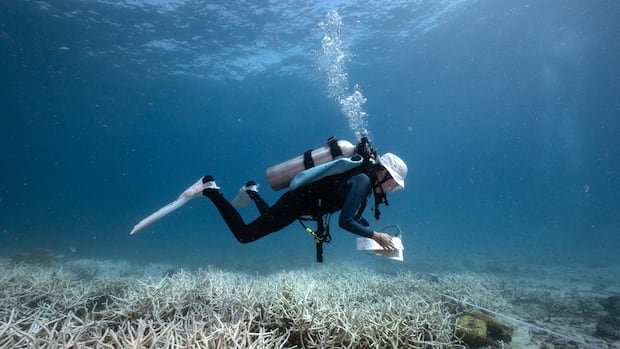

A recent global report on coral reefs reveals a significant decline in the proportion of living hard coral stalks worldwide. The report also highlights concerns about an upcoming potentially record-breaking El Niño peak, indicating a trend towards more intense warming events affecting corals. Marine heatwaves and global bleaching events driven by climate change have led to a substantial reduction in hard coral coverage globally, now standing at around 25%.
According to the Status of Coral Reefs of the World 2025 report, the decline in coral cover, currently at 9.5% relative to previous decades, underscores the ongoing threat to coral reefs. This loss is attributed to climate change-induced heat stress, impacting the majority of the world’s coral reefs.
The report, based on data from nearly 37,000 reef sites, shows a consistent downward trend in hard coral cover since 1980. The aftermath of global bleaching events leaves corals weakened and vulnerable to diseases and mortality, affecting the diverse marine life that depends on them for survival.
Despite efforts to monitor and improve data accuracy, challenges remain in assessing coral cover changes comprehensively across regions. The report emphasizes the urgent need for sustained funding and standardized monitoring approaches to better understand the global coral reef situation.
While some regions show stability or growth in coral cover, the overall decline in coral health highlights the urgent need for action. The report advocates for both regional interventions, such as reducing overfishing and pollution, and global measures to mitigate climate change by reducing greenhouse gas emissions.
Research indicates that recent El Niño events have been stronger, posing additional threats to coral reefs already under pressure from climate change. The urgency to address these challenges is underscored by the limited recovery window for coral reefs, emphasizing the critical need for immediate action to safeguard these vital ecosystems.