
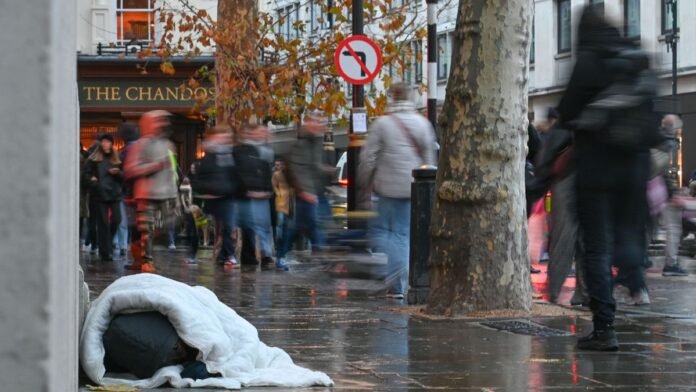

Ministers have made a commitment to reduce by half the number of individuals compelled to sleep on the streets and to put an end to the troubling situation of families being stuck in B&Bs. This initiative is part of a fresh, significant homeless strategy unveiled today, supported by £3.5 billion in funding, aimed at addressing the issue of rough sleepers.
The National Plan to End Homelessness outlines three primary goals to be accomplished by the end of the current parliament term: cutting the number of long-term rough sleepers in half, eliminating the improper use of B&Bs for housing families, and preventing more households from experiencing homelessness. The strategy includes a target to reduce by half the count of ex-prisoners who face homelessness upon release and to ensure no eligible individual is discharged onto the streets after hospital stays.
Recent revelations from the Daily Mirror indicated that almost twice as many women are sleeping rough compared to official records. With Christmas approaching, the government cautioned that many are at risk of homelessness, whether it be individuals sleeping on the streets or children struggling in temporary accommodations.
The plan also makes reference to a commitment announced in last week’s child poverty strategy to put an end to the unlawful use of B&B accommodations for families. Recent data showed that by the end of June, there were 2,070 households in England with children exceeding the six-week limit for temporary accommodation.
Housing Secretary Steve Reed emphasized the profound challenge of homelessness, highlighting the importance of stability for families, a safe environment for children, and the basic need for individuals to have a home. He stressed that the strategy was informed by input from those who have experienced homelessness and frontline workers dedicated to preventing it, aiming to create a future where homelessness is rare, brief, and not recurrent.
The strategy release coincides with findings from housing charity Shelter, which estimated that 382,618 people in England, including 175,025 children, will spend Christmas without a home. Shelter combined official homelessness figures with responses from local authorities to estimate that on any given night this year, one in 153 people will be recorded as homeless.
Furthermore, Shelter reported an 8% increase in homelessness numbers compared to the previous year, with a significant portion in temporary accommodation. At least 4,667 individuals were recorded as sleeping rough on a given night, marking a 20% rise from the previous year.
A substantial funding injection of £37 million aims to enhance support and services from voluntary, community, and faith sectors, recognized as frontline responders to the crisis. Local authorities will receive a boost of £950 million to bolster the provision of high-quality temporary homes, with an additional £30 million allocated to prevent the use of poor-quality emergency accommodations.
Homelessness minister Alison McGovern emphasized the collaborative effort required to prevent homelessness and provide swift and effective support to those in crisis. She highlighted the financial implications of current failures, with temporary accommodation costs escalating and underscored the strategy’s aim to save money and transform lives.