
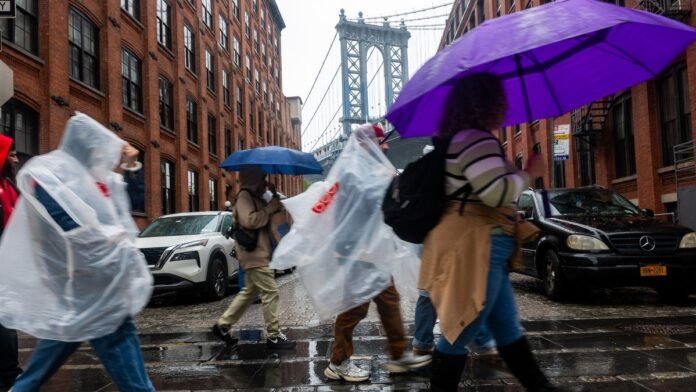

New York has issued a state of emergency as a severe winter storm approaches the United States. Governor Kathy Hochul announced the declaration during a press conference before the anticipated massive storm. The state is well-prepared with an ample supply of salt for road treatment and has authorized all state employees to work remotely on Monday.
Up to now, 14 states have also declared emergencies as the nation gears up for heavy snow, ice, and freezing rain due to a convergence of weather systems. The storm, originating over the Rocky Mountains and Great Plains, is forecasted to impact southern and midwestern states starting Friday, moving across the east coast by Saturday, and reaching Maine by Sunday.
The National Weather Service (NWS) has cautioned that the storm will bring widespread heavy snow, sleet, and freezing rain from the Southern Rockies to New England, affecting areas from Texas to Washington DC, New York, and Boston. Approximately 160 million people, almost half of the country’s population in 30 states, are predicted to be impacted by snow and ice, with some regions expecting over 12 inches of snow by the weekend’s end.
States under emergency declarations include Alabama, Arkansas, Georgia, Kansas, Kentucky, Louisiana, Mississippi, Missouri, New York, North Carolina, South Carolina, Tennessee, Texas, and Virginia. The winter storm is anticipated to bring heavy snow, blowing snow, and potentially dangerous wind chills, as per the NOAA’s National Severe Storms Laboratory.
The NWS warned that the storm could lead to significant ice accumulations, prolonged power outages, tree damage, and hazardous travel conditions. Subsequently, communities from the Southern Plains to the Northeast could face bitterly cold temperatures and dangerous wind chills, impacting travel and infrastructure.
President Donald Trump, known for his skepticism of climate change, expressed surprise over the extreme weather conditions on social media. Meteorologists attribute the current weather pattern to the Polar Vortex, which is driving Arctic air across North America. Scientific findings suggest that Arctic warming may disrupt the polar vortex, potentially leading to extreme winter weather events.