
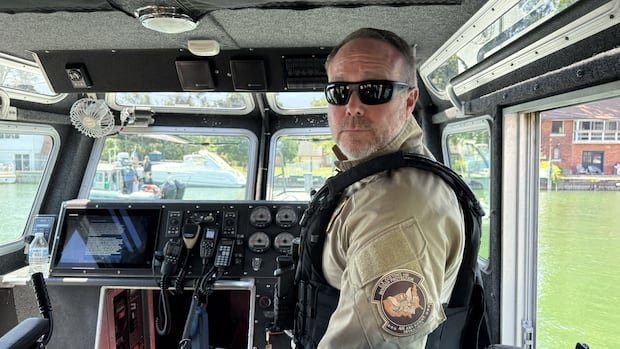

Tim Thayer, dressed in a black bulletproof vest with a gun holstered at his side, smoothly adjusts the throttles of four 350-horsepower engines, propelling the 18,000-pound U.S. Customs and Border Protection boat into action on the Detroit River. Thayer serves as a marine interdiction agent, part of a team that monitors the waterways comprising the Canada-U.S. border in this region.
Assigned to the Detroit sector covering Michigan, Ohio, Indiana, and Illinois, Thayer faces the unique challenge of overseeing the entire 1,388-kilometer border between the two countries, which is entirely water-based. The proximity of Windsor, Ontario, south of Detroit, connected by bridges and a tunnel, sees around seven million individuals crossing annually.
Thayer’s watchful gaze scans the Windsor shoreline during a warm afternoon, vigilant for any unusual activities. He notes the constant flow of people, narcotics, and firearms crossing between the U.S. and Canada during their enforcement patrols on the Detroit River.
While the Windsor-Detroit corridor was historically notorious for smuggling alcohol during the Prohibition era, the current illegal activities on the Detroit River are not as prominent. However, the presence of numerous recreational boaters poses a challenge for law enforcement efforts.
Chief Kris Grogan emphasizes the importance of intelligence and partnerships in securing the region, given the volume of boats that could potentially be involved in illicit activities. Recent statistics reveal that U.S. border officials seized a substantial amount of illegal drugs, including fentanyl, in the Detroit sector, highlighting the ongoing concerns of drug and weapon trafficking.
Despite U.S. President Donald Trump’s assertions regarding drug trafficking and border security, the actual situation along the northern border is more complex. While some illegal substances and firearms flow northward, the U.S. also serves as a transit point for drugs entering Canada from Mexico and South America.
Canadian border security expert Kelly Sundberg highlights the need for enhanced staffing, training, and resources to address border security challenges effectively. The ongoing discussions and data analysis indicate that the drug trafficking threat from Canada, particularly regarding fentanyl, is not as significant as portrayed by some political figures.
Amidst political tensions, U.S. border agents acknowledge the enduring cooperation with Canadian counterparts, emphasizing the importance of their partnerships. As Thayer observes an RCMP boat passing by with the Gordie Howe bridge in the background, it symbolizes the complex yet resilient relationship between the two neighboring countries.