


Kaila Richard, who now operates the oyster farm in Dock River, Western P.E.I., reminisces about her late father who managed the farm until his untimely passing in 2021.
“When we are out here, I feel my father’s presence,” Kaila shared, reflecting on the farm’s journey alongside her husband, Bruce Richard.
The couple invested significantly in upgrading the farm, acquiring new equipment, and dedicating long hours to nurture their oyster crop. However, their efforts face dire threats as two diseases devastate the Island’s oyster industry.
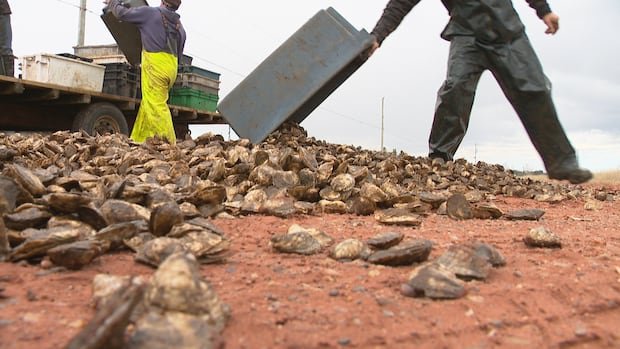
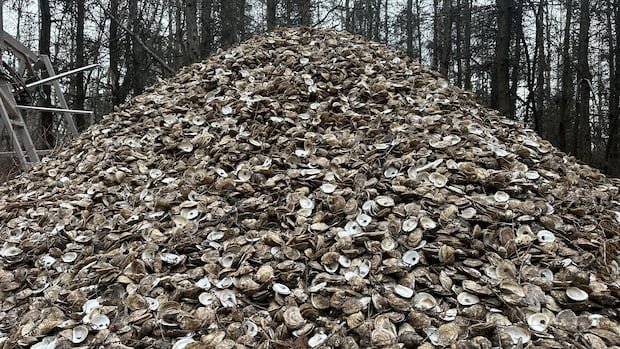
Oyster farmers have witnessed a distressing sight of millions of deceased oysters, forming massive shell mounds across P.E.I.
Bruce lamented, “The situation across the island is catastrophic. In our area alone, a dozen farmers are grappling with substantial losses, reaching up to 95 percent.”
Numerous oyster farmers in Western P.E.I. are witnessing complete mortality rates in their cages after winter. The region is grappling with two devastating oyster diseases – MSX and dermo. CBC’s Nancy Russell investigates the story.
The diseases, Multinucleate Sphere Unknown (MSX) and dermo, were first detected in P.E.I. waters in 2024 and 2025, respectively. While harmless to humans, these parasites prove fatal to oysters, leading to reports of total mortality among growers.
Both provincial and federal governments have announced diverse support initiatives, including financial aid, mental health services, and authorization for importing disease-resistant oyster seed to replenish stocks. However, the cultivation process for these seeds spans at least three years, with uncertain outcomes.
Farmers emphasize the urgent need for continuous financial backing to sustain their operations amidst the crisis.
Jeff Noye, an oyster grower and the mayor of Tyne Valley, stressed the cultural significance of oyster farming in P.E.I., expressing concerns that corporate entities might exploit the situation.
Read more