
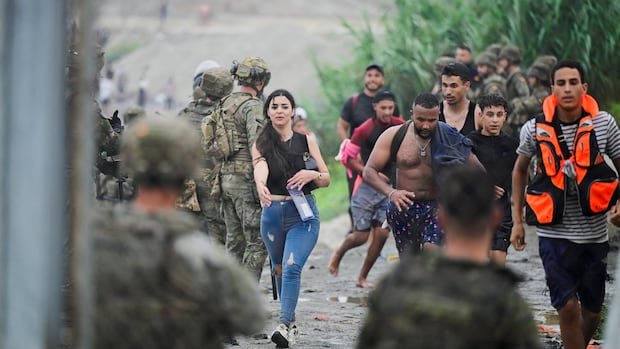

Spain and Morocco have fortified the border fence of a Spanish enclave, effectively curtailing mass crossings following a surge of tens of thousands of people arriving by sea and land. According to officials, at least 57 individuals have lost their lives after approximately 60,000 individuals entered Ceuta over the past few days. By 6 p.m. local time on Friday, an estimated 48,300 migrants had voluntarily returned to Morocco as reported by Spain’s Interior Ministry.
The mass influx into Ceuta, a small Spanish-held peninsula protruding into the Mediterranean from Morocco, triggered shock and discord in Europe. France announced heightened border checks with Spain, while Italy threatened to suspend Spain from the European Union’s internal open border arrangement.
Moroccan authorities stationed water cannon trucks at the gates of Ceuta, pushing back individuals and utilizing batons and tear gas to deter further border crossings. The aftermath of clashes included the sight of a charred bus and seven cars in the vicinity.
Despite a court ruling imposing restrictions on special “border rejection” regulations allowing immediate expulsions from the enclave, Spanish authorities pledged swift expulsion of those who entered illegally. Prime Minister Pedro Sanchez condemned the mass crossings as a violation of Spain’s territorial sovereignty and urged Morocco to intensify efforts to stem the outflow of people.
Ceuta and Melilla, another Spanish autonomous city in northern Morocco, boast the European Union’s sole land borders with Africa. While both cities, each home to around 85,000 residents, periodically witness surges in attempted migrant crossings, Thursday’s influx was unprecedented in scale.
Territorial Policy Minister Angel Victor Torres suggested that a recent ruling by Spain’s Supreme Court, preventing the summary return of migrants intercepted at sea while aiming to reach Ceuta or Melilla under special rules, may have contributed to the surge.
Migrants frequently swim from the Moroccan town of Fnideq, covering approximately five kilometers to reach Ceuta located on the northern African coast. Some opt for the shorter distance from the nearby town of Belyounech for the crossing attempt. On the Moroccan side, despite reinforced security measures, thousands attempted to cross into Fnideq overnight, with groups seeking alternative routes along the coast.
Migration remains a contentious issue in Europe, particularly as right-wing parties gained traction following the 2015 crisis when over a million individuals traversed the continent predominantly on foot, seeking asylum, many fleeing conflict in Syria.
In response to the recent events, several European countries have announced increased border surveillance and patrols. Germany expressed support for Spain’s commitment to preventing illegal migrant entries onto European soil, while Italy’s Prime Minister hinted at potential extraordinary measures, including suspending the Schengen Area with Spain, to safeguard borders and citizens.
As debates on immigration policies escalate, President Donald Trump characterized the Ceuta crossings as resembling an invasion during a cabinet meeting, highlighting the potential consequences if his political party is not re-elected in the upcoming midterm elections.
While Spain’s government maintains a firm stance on illegal crossings, emphasizing the economic contribution of immigrants supported by extensive data, the country recently offered a mass amnesty program leading to hundreds of thousands of individuals seeking citizenship in the past year.
Italy’s Foreign Minister criticized Spain’s citizenship grant initiative, alleging it encouraged human trafficking, prompting a rebuttal from Spain’s Foreign Minister, underscoring the need for solidarity and dismissing the accusations of partisan demagoguery.