
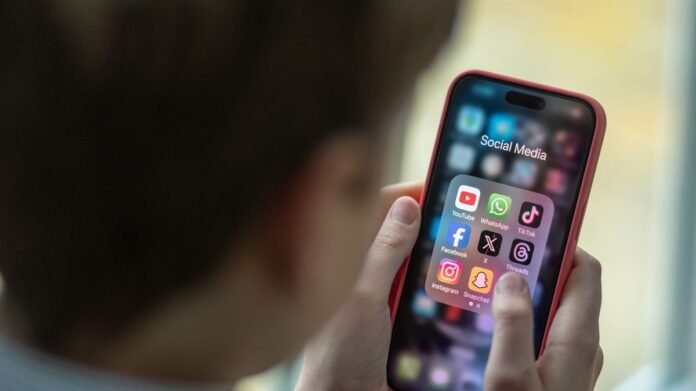

Social media use for individuals under the age of 16 is being advocated for by a major teaching union to enhance focus in schools and safeguard mental well-being. The National Association of Schoolmasters Union of Women Teachers (NASUWT) has urged the government to compel prominent tech companies to block minors from accessing their platforms, following Australia’s prohibition of social media for those under 16 in December. According to NASUWT, growing evidence indicates that unrestricted access to social media is contributing to deteriorating behavior in schools, negatively impacting the mental health of youths, and exposing them to violent and sexually explicit content.
The discussion comes in the wake of controversy surrounding X’s AI chatbot Grok, which has been utilized to generate sexualized images of individuals, including minors, upon user requests. NASUWT’s general secretary, Matt Wrack, emphasized the challenges faced by teachers due to the consequences of an unsuitable social media environment for children.
Wrack stated, “Social media companies consistently demonstrate a lack of responsible action unless obligated to do so. To effectively protect children, preserve their mental health, and address the behavioral crisis in schools, an immediate statutory ban on social media for those under 16 is imperative.”
Through a survey conducted in 2025 involving 5,800 educators, NASUWT discovered that approximately 81% reported a rise in instances of violent and abusive conduct among students. Nearly 59% attributed deteriorating behavior to social media influence. Additionally, in a separate poll of 300 members, NASUWT found that 89% supported the implementation of a legal ban on social media for individuals under 16.
Liz Kendall, the Technology Secretary, expressed readiness to support the regulatory body Ofcom should it decide to block X for non-compliance with UK regulations. Recently, X adjusted Grok’s settings, notifying users that only paying subscribers could request image alterations.
Concerns raised by the head of the Office for Standards in Education, Children’s Services and Skills (Ofsted) at the end of the previous year highlighted the impact of social media on children’s attention spans and disrespectful behavior. A poll conducted by Mirror showed that 64% of respondents favored a social media ban for those under 16, while only 19% opposed the notion.
Wrack emphasized, “Our members indicate that social media significantly contributes to behavioral issues, anxiety, and disengagement in classrooms. Children deserve an environment where they can develop, learn, and build healthy relationships without being ensnared in an online world that exploits their vulnerabilities.”
Responding to the issue, Daniel Kebede, General Secretary of the National Education Union, voiced support for NASUWT’s stance, emphasizing how social media is encroaching on children’s childhoods and replacing genuine interactions with profit-driven online platforms.
A Government representative underscored the support provided to headteachers in maintaining a conducive learning environment in schools, with many already restricting phone use during the school day to avoid disruptions. The Online Safety Act has been instrumental in ensuring age-appropriate online experiences for children, mandating social media companies to shield minors from harmful content while allowing them to safely explore the digital realm.