
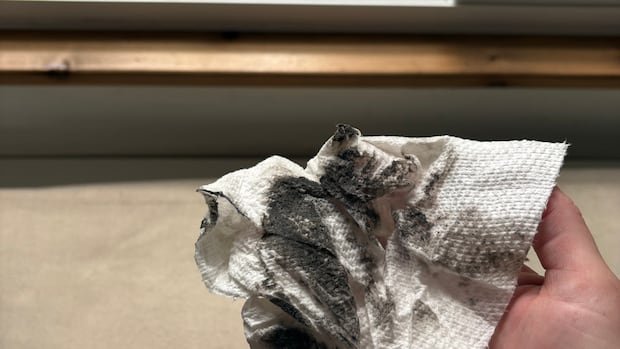

A group of scientists based in Hamilton has uncovered insights into the issue of soot accumulation in neighborhoods near the city’s industrial zone. Local residents have long voiced concerns about a dirty, dark substance coating their properties, with a recent spike in fallout experienced in early July.
Sarah Styler, an environmental chemistry associate professor at McMaster University, along with Grace Yao, a PhD candidate in Styler’s lab, are part of a research project titled “What’s the Grime?” aimed at addressing this matter. Through collaborative efforts with volunteers who collected samples across the city in 2024 and 2025, the researchers identified toxic chemicals in the soot linked to coal combustion. Additionally, higher levels of dust and polycyclic aromatic hydrocarbons (PAHs) were detected closer to the industrial sector in northeast Hamilton.
The study, which received a $15,000 grant from the university in 2024, was conducted in partnership with Environment Hamilton. Styler and Yao, both residents of affected areas in Hamilton, emphasized the long-standing nature of the soot issue, tracing references to it in news archives dating back to the 1950s.
Sampling kits were utilized to gather soot samples from the homes of 50 volunteers across the city, with periodic analysis revealing varying levels of pollutants. Styler highlighted the presence of more dust and toxic compounds near the industrial area, particularly PAHs, which showed higher concentrations during winter months.
While the study focused on 13 specific PAHs, Styler acknowledged the potential presence of other harmful substances in the soot, describing it as a viscous mess. Resource constraints limited the scope of the investigation, leaving open the possibility of additional contributors to the fallout beyond coal combustion.
Styler’s team refrained from pinpointing industrial sources responsible for the PAHs, emphasizing the need for continued monitoring and enhanced analytical capabilities to delve deeper into the matter. The findings, according to Styler, align with the expectations of residents directly impacted by the fallout, indicating an industrial origin for the soot.
Despite community frustrations over insufficient information disclosure from official channels, ongoing testing by the Ministry of the Environment, Conservation and Parks aims to identify the source of the soot. Styler emphasized discrepancies between her team’s findings and previous assertions linking the soot primarily to road dust, underscoring the industrial nature of the pollutant as supported by community reports.
The researchers plan to share their study outcomes at a community meeting on Aug. 20, with a manuscript for peer review in progress. Future endeavors include expanding volunteer participation, exploring additional compounds in the soot, and investigating effective cleaning methods for the affected areas.