
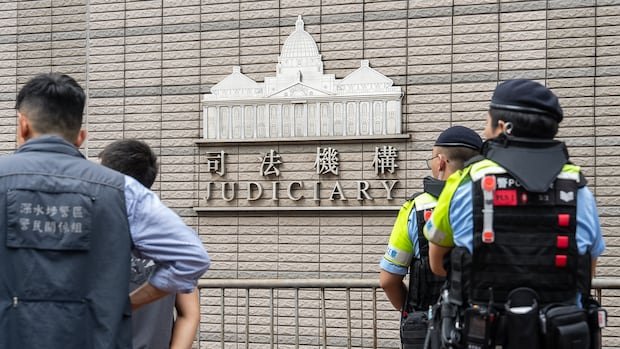

Two individuals who previously organized Hong Kong’s annual vigil commemorating the 1989 Tiananmen Square crackdown have been found guilty in a national security case under a China-enforced law that has stifled the city’s once-active pro-democracy movement. Lee Cheuk-yan and Chow Hang-tung, former leaders of the Hong Kong Alliance in Support of Patriotic Democratic Movements of China, were convicted of inciting subversion in 2021 under the national security law, with a potential maximum prison sentence of 10 years. Additionally, the alliance itself was also held accountable in the ruling.
The judges determined that the alliance’s advocacy to “end one-party dictatorship” was not a call for the ruling Communist Party to revert to a multi-party system as per the constitution but rather aimed to abolish its leadership position within the constitution. The judges interpreted the term “end” in the phrase as synonymous with “overthrow” and “undermine.” Despite the law’s introduction, the defendants persisted in their stance, disregarding that it contradicted the constitution, which designates the party’s leadership as a fundamental characteristic of socialism with Chinese characteristics, falling under the purview of “other unlawful means” according to the security law.
This verdict is part of a series of legal actions targeting Hong Kong’s erstwhile robust pro-democracy movement, which has been largely dismantled by authorities in Hong Kong and mainland China. The candlelight vigil organized by the alliance had been a significant public event for three decades, attracting thousands annually to commemorate the victims in China. However, the event was banned in 2020 during the onset of the COVID-19 pandemic, just prior to the implementation of the security law by Beijing to suppress the massive 2019 anti-government protests.
Lee and Chow, upon exiting the courtroom, acknowledged the gallery with smiles and waves. They are anticipated to receive their sentencing at a later date and will seek mitigated penalties during the upcoming week, as indicated by one of the judges. Observers view this trial as emblematic of the dwindling freedom of expression in the former British colony since its handover to Chinese control in 1997.
The judges refrained from disclosing the rationale behind the conviction during the court session, with the complete judgment set to be published online subsequently. This legal development underscores the broader context of diminishing civil liberties in Hong Kong and the stifling of dissenting voices within the territory.
—
Keywords: Hong Kong, Tiananmen Square, crackdown, national security law, pro-democracy movement, Communist Party, constitution, subversion, leadership, China, alliance, verdict, democracy, expression, ruling, judiciary, trial, activists, sentencing, protest, political, law, human rights, advocacy, legal, court, ruling party