
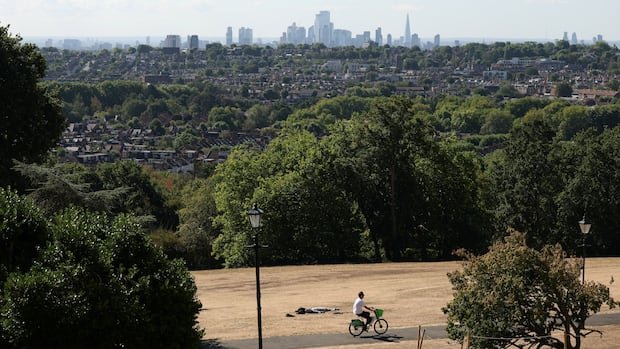

In the midst of a heat wave and severe drought in Britain this summer, Divya Hariramani was trimming a plum tree in south London when she noticed an issue with one of its branches. The branch was starting to detach from the tree, a sign of stress according to the workers at Mitcham Community Orchard. Hariramani, known for her documentation of fruit trees and their caretakers in London on her social media account Fruity Walks, explained that the heat was causing the tree to struggle in providing enough water to all its parts.
Although London is famous for its stone architecture, it is also home to a mature urban forest, considered one of the largest globally. However, this year has been challenging for the city’s green canopy due to five consecutive heat waves and a significant lack of rainfall, putting stress on plants and wildlife. Future projections indicate a grim outlook for London’s eight million trees, with a recent report from Royal Botanic Gardens Kew suggesting that 73 percent of the city’s trees could be at risk of perishing due to climate change by the end of the century.
Kew Gardens, in collaboration with the Greater London Authority, evaluated over a million public trees and found that a majority are ill-suited to the anticipated climate conditions by 2090 without emission reduction measures. Additionally, a considerable percentage of trees are deemed vulnerable. The impact of climate change is already evident, with 400 trees at Kew Gardens perishing in 2022 due to extreme heat and drought. This prompted the gardens to leave a red oak tree skeleton as a poignant symbol of the effects of climate change on London’s trees.
The severe weather conditions in the UK, including a record-breaking dry July, have led to challenges for farmers, food shortages, and wildfires, reflecting the broader impact of climate change. The implications are also visible in London, where park grass has withered, tree branches appear more droopy, and leaves are prematurely falling, giving an autumnal appearance in the summer months.
As London experiences rising temperatures beyond the tolerance of its current tree species, experts are considering introducing different tree varieties. Botanical horticulturist Joe Richomme from Kew Gardens mentioned that projections suggest London’s climate in 2050 may resemble that of present-day Barcelona. Therefore, Kew is exploring tree species that can thrive in hotter, drier climates while enduring England’s wet winters.
Paul Wood, a prominent writer on London’s trees, expressed concerns about the future of the city’s green spaces amidst record heat and drought. Wood highlighted the struggle of native woodlands in London, like Highgate Woods and Sydenham Hill Woods, which are facing challenges due to the changing climate. These ancient trees, some over a thousand years old, hold historical significance and support valuable biodiversity, making their preservation crucial.
The potential loss of London’s iconic trees and woodlands is not just a loss of history but also a blow to the ecosystem they sustain. Wood emphasized the irreplaceable nature of these trees and the urgent need to protect them for future generations.