
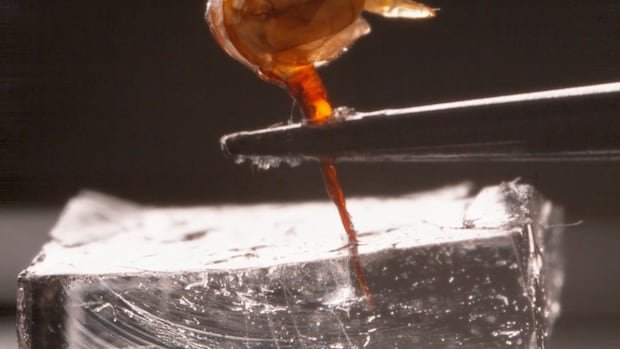

A western honey bee’s stinger serves as a final line of defense, designed to pierce flesh and inject venom, often resulting in the bee’s demise. Recent research in the Proceedings of the National Academy of Sciences sheds light on the efficacy of this defensive mechanism by utilizing high-speed cameras to capture the stinger in action.
Lead author Fiorella Ramirez Esquivel, a postdoctoral researcher at Macquarie University, highlighted the novelty of being able to film the stinger’s function, made possible by modern camera technology. The study employed cameras that could capture hundreds of frames per second to observe the rapid bee stinging process.
Experiments involved live honey bees, with researchers swiftly removing the stinger and analyzing its mechanics before it became inactive. The study revealed a double-piston design within the stinger, where specialized valves drive the stinger deeper while continuously pumping venom from the sac. This intricate mechanism, likened to a car engine with dual pistons, was further explored through 3D printing to simulate the valves’ movement.
Juliana Rangel, an apiculture professor at Texas A&M University, expressed fascination with the study’s detailed insights into the stinging process, surpassing traditional microscopic images. The research highlighted the prolonged venom release post-sting, with stinger movements persisting for up to 15 minutes.
The study emphasized the unique defense strategy of the western honey bee, where workers sacrifice their lives to protect the colony, a behavior known as autotomy. Unlike other bees, the western honey bee possesses barbs on its stinger, aiding in embedding and delivering venom effectively. The stinging mechanism also releases pheromones to signal other bees to join in defending against threats.
While the stinging mechanism may not always be effective against tough skin or fur, its barbed structure and continuous penetration enhance the bee’s chances of deterring attackers. The study’s findings could potentially have medical applications, offering insights into fluid dynamics that could inspire new technologies.
Research on the western honey bee’s stinging mechanism raises intriguing questions about other bee species that produce honey but lack stingers, prompting further exploration into their evolutionary adaptations. The study underscores the intricate nature of bee defenses and the potential applications of studying their unique biological mechanisms.