
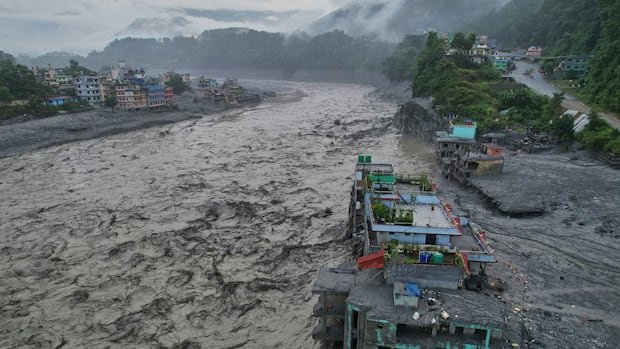

Authorities in Nepal have issued warnings of potential new flooding and advised residents in flood-affected areas to stay vigilant as water levels surged in the Bhotekoshi River. Flood alerts were sent to people’s mobile phones early on Sunday while rescue teams worked to clear a vital highway linking Kathmandu to one of the hardest-hit regions by the devastating floods that occurred on Wednesday, resulting in a death toll of at least 800 individuals and over 3,000 missing in Nepal and Tibet.
The recent alerts followed notifications from Chinese authorities to their Nepalese counterparts regarding an increase in water flow upstream. According to Dharam Raj Uprety, the head of Nepal’s National Disaster Risk Reduction and Management Authority, Chinese state news agency Xinhua reported that a newly formed lake post-Wednesday’s floods in the high mountains had mostly drained. However, caution was advised by the ministry regarding a crater situated 5.6 kilometers upstream containing an estimated 1.4 million cubic meters of water that still posed a risk and mandated close monitoring.
As of Sunday, Nepal’s disaster agency confirmed the death toll had risen to 788 with 2,502 individuals missing, while Chinese authorities reported 16 fatalities and 546 missing persons on the Chinese side of the border. Among the missing are hundreds of people from various countries who were in the area for work, tourism, or pilgrimage purposes.
The search for missing individuals continues, with Canada’s foreign affairs minister, Anita Anand, announcing that one Canadian reported missing had been found safe. However, 31 Canadians are still unaccounted for, with families like Seema Rawla’s, whose brother is missing, seeking government assistance. Rawla expressed frustration at the lack of substantial help from Canadian authorities, emphasizing the need for more support and resources.
Rescue operations are ongoing at multiple hydroelectric projects, with a significant focus on the Upper Trishuli complex, where about 350 individuals are believed to be trapped inside a tunnel. Nepali troops, along with specialists from China and India, are actively involved in the rescue efforts.
In severely affected regions like Dhading, residents are returning to assess the damage to their homes, salvaging what they can. Infrastructure damage, power outages, and logistical challenges persist in the aftermath of the floods, with communities facing hardships and limited access to essential services.
The flash floods, triggered by a glacial collapse in the Himalayan region, have raised concerns about climate change’s impact. Nepal’s foreign affairs minister highlighted the disproportionate impact of climate change on the country, calling for a global response to address the challenges posed by environmental shifts. Scientists have noted the increased risk of such disasters in the Himalayas due to rising global temperatures, emphasizing the urgency of climate action.