
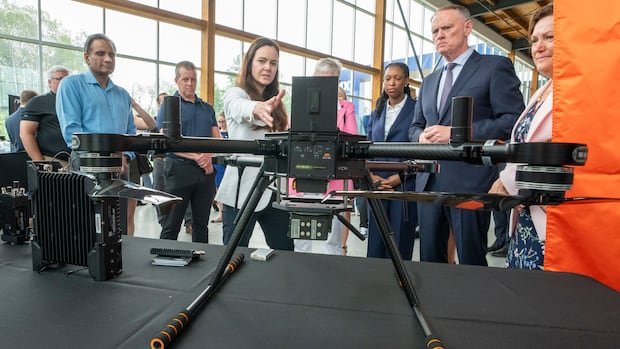

The Canadian Armed Forces recently conducted a comprehensive evaluation of nearly twenty drone manufacturers at a remote site near Ottawa to explore a variety of unmanned systems and potential partnerships with adaptable companies. The initiative, referred to as RED COBALT Uncrewed Systems Accelerator 2026, allowed military personnel to test aerial, ground, and maritime drones, along with long-range precision strike systems. Lt.-Gen. Darcy Molstad, overseeing the military’s joint forces command, highlighted the event’s significance.
Twenty companies, predominantly Canadian, participated in the demonstration held in Killaloe, Hagarty, and Richards, Ontario. Selection criteria emphasized Canadian ownership or partnerships, aligning with the federal government’s defense industrial strategy. While Canadian suppliers offer innovation, much of the practical battlefield drone expertise and technology is concentrated in Ukraine and Eastern Europe.
Molstad expressed confidence in Canadian companies’ ability to meet military requirements and adapt to evolving drone technology swiftly. The military’s specific needs include aerial reconnaissance and surveillance drones, ground drones capable of navigating complex terrain, and maritime platforms for surface and subsurface warfare. Additionally, the military is exploring precision deep-strike capabilities, similar to those used in Ukraine targeting Russian oil facilities.
Despite a delayed adoption of dedicated drone capabilities, the Canadian military is progressing. In 2023, a contract was signed with General Atomics for the procurement of 11 MQ-9B SkyGuardian drones, set for delivery starting in 2028. The military has also acquired a fleet of 50 Teal 2 micro drones for local surveillance. Furthermore, there are plans to establish a $30-million military drone research and development facility in Mirabel, Quebec, announced by the federal government last month.