
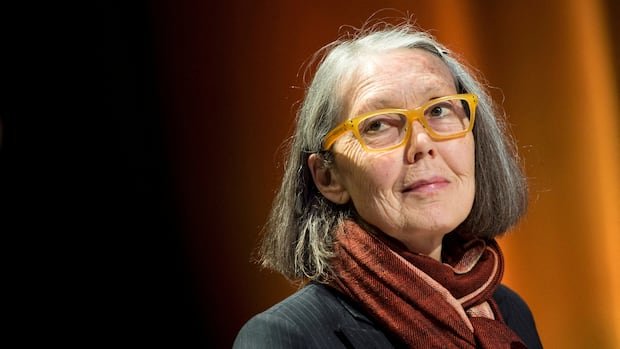

Canadian poet and essayist Anne Carson, aged 76, was honored with the Nobel Prize in Literature by the Swedish Academy in Stockholm. The award recognized her innovative and daring body of work, which engages with the classical tradition to create fresh forms for contemporary literature. Carson, who holds citizenship in both Iceland and Canada, was surprised to learn of her win while in Reykjavik, Iceland, where she often spends her time.
Congratulatory messages poured in from various quarters, including Canada’s prime minister, Mark Carney, who praised Carson for her unique style and imaginative reinterpretations of classic tales. Carson, an alumna of the University of Toronto, where she obtained her bachelor’s, master’s, and PhD degrees in classics, was hailed by the university for her remarkable achievement.
Having taught at prestigious institutions such as Princeton, McGill, Stanford, and New York universities, Carson has left a profound impact on her students and the literary world. Her profound influence on aspiring writers was highlighted by one of her former students, Jin Jin Xu, who lauded Carson’s ability to reshape their understanding of literature.
Carson, born in Toronto, has garnered acclaim for her contemporary adaptations of ancient Greek and Latin texts. Her works, such as “Norma Jeane Baker of Troy” and “Canicula di Anna,” have received numerous awards, showcasing her talent and creativity. The Swedish academy commended her notable contributions in the 1990s and beyond, recognizing the boundary-pushing nature of her poems like “Glass, Irony and God” and “Autobiography of Red: A Novel in Verse.”
In addition to her literary accomplishments, Carson has ventured into translating and performing Greek and Latin works, as well as collaborating on operatic projects. Despite facing health challenges, such as a recent Parkinson’s disease diagnosis, Carson’s dedication to her craft remains unwavering.
As the third Canadian-born recipient of the Nobel Prize in Literature, following in the footsteps of Saul Bellow and Alice Munro, Carson joins an illustrious group of laureates recognized for their outstanding contributions to humanity. The prestigious award, established in 1901 by Alfred Nobel, continues to honor individuals who have made significant contributions to society.