

On Monday, Yemen’s Houthis, who are aligned with Iran, initiated a fresh assault on Saudi Arabia, prompting Gulf Arab nations to delay scheduled discussions with Iran, which raises fears that the conflict in the Middle East could escalate and endanger global oil supplies.
The Houthis announced on Monday that they launched a barrage of missiles and drones targeting a military airbase in Khamis Mushait, located in southern Saudi Arabia. Their aim was to hit aircraft hangars, radar installations, runways, and munitions storage facilities in response to Saudi airstrikes in Yemen.
In reaction, Saudi authorities issued emergency warnings in Khamis Mushait and three additional southern cities.
This latest assault comes after an incident on Friday, which Riyadh attributed to Iran-backed militants in Iraq. This attack disrupted the country’s east-west pipeline, a critical route for Gulf oil exports that bypasses the blockaded Strait of Hormuz.
Adding to the strain on global oil supplies, the Houthis have made significant territorial gains in Yemen recently, including the capture of Perim Island, situated at the entrance of the Red Sea, last week.
The renewed hostilities in Yemen present a new dilemma for U.S. President Donald Trump, who is under pressure from Gulf partners to assist in curbing the Houthis yet aims to avoid escalating the conflict further.
Since 2015, Saudi Arabia has led a coalition fighting against the Houthis, but the situation had largely stabilized under a ceasefire in recent years. However, hostilities reignited this month, with the Houthis advancing against forces loyal to the internationally recognized government.
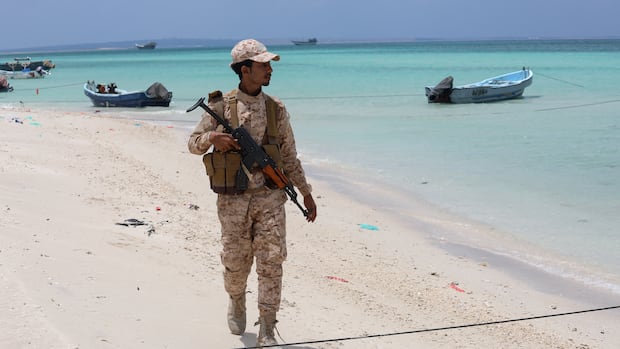
Iran-backed Houthi rebels in Yemen are expanding their control over a key Middle Eastern shipping route, adding further pressure to global oil supplies and prices.
According to three sources, Washington has so far resisted Saudi demands for direct military involvement, aside from providing intelligence support. Over the weekend, Trump stated that he had conversed with the Saudi crown prince, and the Houthis had also reached out to Washington, urging it to refrain from engaging in the conflict.
Saudi state media reported that Crown Prince Mohammed bin Salman held a meeting with U.S. regional commander Adm. Brad Cooper in Jeddah on Monday.

Global oil supply fears are mounting after a drone attack launched from inside Iraq led to Saudi Arabia closing the East-West pipeline facility in the country’s Hejaz region.
The International Organization for Migration estimates that approximately 82,000 Yemenis have fled from the ongoing conflict since the beginning of the month, as the Houthis have advanced into cities, including the historic port of Mocha last week.
Oman was scheduled to host a meeting on Monday with Iran and Gulf nations to discuss negotiations aimed at reopening the Strait of Hormuz, a vital passage that before the war accounted for 20 percent of the world’s oil exports. However, Oman announced that the meeting had been postponed at Saudi Arabia’s request.
Trump reiterated his claim that Iran is eager for a quick agreement, but Mohsen Rezaei, secretary of Iran’s Supreme National Security Council, dismissed the president’s statement as a distraction, asserting on X, “No talks until Iran’s conditions are met.”
On Monday, crude oil prices surged over four percent before settling with about a one percent increase.
Traders indicated that a prolonged halt of the Saudi pipeline could potentially cut global oil supply by as much as four percent. However, Riyadh has not provided a timeline for when operations might resume.
-
Houthis seize strategic island, Saudis close pipeline as fighting escalates
-
Iraq scrambles to address fallout from alleged militia attack on Saudi oil pipeline
Highlighting the precarious nature of maritime operations in the region, conflicting reports emerged regarding the circumstances surrounding damage to an oil tanker.
Without specifying a date, Iran’s Revolutionary Guard Corps claimed that the Panamanian-flagged oil tanker El Gaia was damaged by mines while traversing a restricted area south of the Strait of Hormuz, according to Iran’s Fars news agency on Monday.
In contrast, the U.S. military’s Central Command quickly refuted this claim, stating that the tanker had been “struck by an Iranian missile last month and rendered inoperable.”