
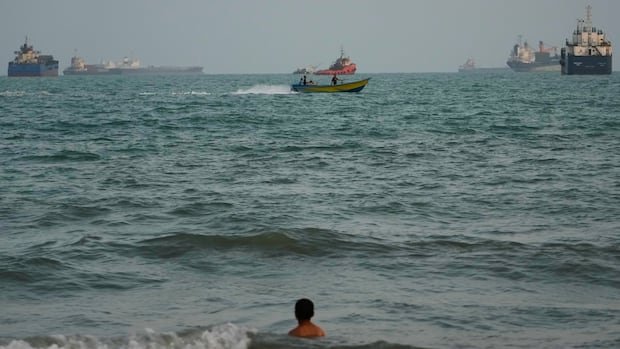

Iran’s new leader of the Supreme National Security Council announced plans to establish an “exclusion zone” outside the Strait of Hormuz to target vessels seeking to pass through. Mohsen Rezaei revealed this intention during an interview with Iran’s state broadcaster following the U.S. strike on three Iranian oil tankers in retaliation for Iran’s missile attacks on American warships. These actions were deemed a dangerous escalation by experts, especially considering Iran’s history of targeting commercial ships at sea.
The specifics of the exclusion zone are yet to be fully disclosed, but Rezaei mentioned that it will stretch from the U.S. naval blockade line towards the Strait of Hormuz and into the Persian Gulf. Vessels identified within this area intending to transit through the strait will face sanctions, according to Rezaei.
The location of the U.S. naval blockade, which has redirected numerous commercial ships and disabled a few, remains uncertain from Iran’s perspective. As tensions persist, the U.S. has ramped up economic pressure on Iran, introducing new measures amidst collapsed negotiations and ongoing sporadic confrontations.
In a separate incident, Iran claimed to have targeted a U.S. vessel attempting to enter the Strait of Hormuz, a claim swiftly dismissed as false by the U.S. military. This exchange of accusations comes amid renewed hostilities between the two countries, with both sides engaging in military actions and economic strategies to assert dominance.
The conflict, which started with U.S. and Israeli strikes on Iran earlier in the year, has seen intermittent violence despite attempts at ceasefire agreements. The recent attacks on the strait and Iranian territories signify a resurgence of aggression, with casualties reported and both nations vying for supremacy.
The Trump administration seems to be pursuing a dual approach by responding militarily to strait-related incidents while also targeting financial institutions handling Iran’s funds. Conversely, Iran’s new hardline leadership appears resolute in facing sanctions and sustaining its operations, including finding alternative ways to ship its oil amidst blockades and restrictions. The unresolved issue of Iran’s nuclear program continues to complicate diplomatic efforts, with calls to refer Iran to the United Nations Security Council for alleged non-compliance with nuclear agreements.
The vital role of the Strait of Hormuz as a global shipping route for oil and gas remains central to the conflict, with the U.S. Energy Secretary highlighting the significance of the strait in maintaining energy flows. Despite challenges, efforts are being made to ensure the continued passage of oil through the strait with naval escort support, although the situation remains precarious.
Overall, the standoff between the U.S. and Iran underscores the complex geopolitical tensions in the region, with both sides engaging in military posturing and economic maneuvers in a bid for supremacy.