
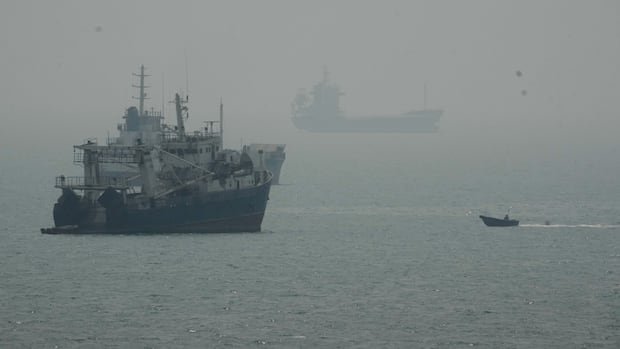

Iran announced on Wednesday that it had carried out an assault on 10 vessels in the vicinity of the Strait of Hormuz in retaliation for the sinking of five Iranian oil tankers by the United States. This marked the most significant exchange of attacks on maritime targets by both sides since the start of the ongoing conflict. The Islamic Revolutionary Guard Corps (IRGC) of Iran stated that they had launched a ballistic missile strike on a U.S. military base near Al Azraq in eastern Jordan and had targeted two U.S. ships along with eight oil tankers that were attempting to traverse a restricted area in the Strait of Hormuz.
The incidents in and around this critical waterway caused a spike in oil prices, with the international Brent crude benchmark surpassing $100 per barrel for the first time since July. Throughout the conflict, oil prices had previously dropped as low as $70 amid hopes for a resolution between the U.S. and Iran to facilitate the safe movement of oil tankers out of the Persian Gulf. The escalating hostilities between Saudi Arabia and the Iran-aligned Houthis in Yemen have added further uncertainty to energy markets. Recently, the Houthis launched attacks on four Saudi cities, resulting in significant fires at oil installations, visible from space, and leaving 73 people injured according to Saudi authorities.
Consumers in the United States have been impacted by rising gasoline prices, with the average cost of regular gasoline reaching $4.15 per gallon on Tuesday, reflecting a 26% increase from a year ago. Diesel prices stood at $5.90 per gallon, marking a 59% surge compared to the same day last year. The situation has become a politically sensitive issue ahead of the upcoming November midterm elections, which could potentially shift the balance of power in the Senate and House of Representatives.
Furthermore, Canada has also witnessed a surge in gas prices since the conflict began, seeing hikes ranging between 25% and 40% in various regions. To alleviate the financial burden on consumers, the federal government has extended the gas tax holiday until the end of January.
The U.S. military confirmed the destruction of five Iranian oil tankers, citing video evidence of the vessels ablaze before sinking. These actions were in response to the IRGC’s targeting of a U.S. Navy warship with ballistic missiles on two consecutive days, as stated by the U.S. Central Command. Iran, on the other hand, has declared an expanded restricted zone around the strait and asserted the deployment of more advanced missiles to engage U.S. ships.
Iran’s Revolutionary Guards revealed plans to establish a maritime restricted area extending from Chabahar in Iran into parts of the Gulf of Oman and the Arabian Sea, with specific coordinates to be announced. In a separate incident, an Iraqi fuel oil tanker was reportedly struck by a drone in Iraqi territorial waters, causing a fire aboard the vessel, though no casualties were reported among the crew members.
The United Kingdom Maritime Trade Operations agency reported vessels in the northern Gulf and Gulf of Oman being hit by disabling fire during recent military activities in the region. Iran has also issued threats against oil tankers in Kuwaiti and Bahraini ports, further escalating tensions in the region and disrupting the flow of global oil through the Strait of Hormuz.
As the conflict persists, the United States has imposed a military blockade on Iranian ports, claiming to assist tankers in traversing the strait. However, the effectiveness of these measures in ensuring the passage of oil remains uncertain, complicating the assessment of the actual amount of oil escaping the blockade.
In summary, the ongoing confrontations between the U.S., Iran, and regional actors continue to impact global energy markets and consumer prices, with ramifications felt across various countries and industries.