
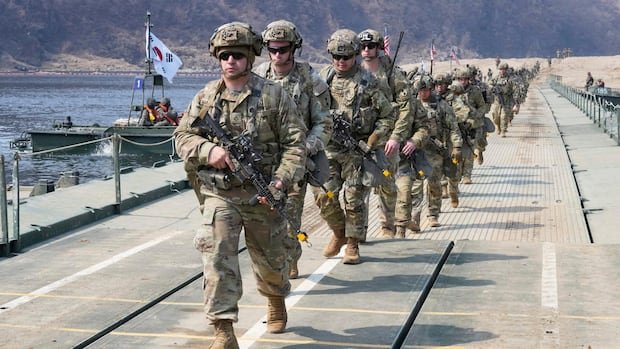

U.S. President Donald Trump has directed the Pentagon to reduce planned joint military exercises with South Korea, citing a lack of support in denuclearizing Iran and emphasizing his positive relationship with North Korean leader Kim Jong-un. Trump expressed on social media that the upcoming exercises, deemed costly, send an inappropriate and hostile signal to North Korea, which he described as non-threatening and respectful during his presidency.
Stating that it was too late to cancel the exercises, Trump instructed Secretary of War, Pete Hegseth, to significantly scale back the Joint Military Exercises. He also mentioned that when he proposed South Korea’s participation in Iran’s denuclearization efforts, they declined. This move echoes a previous attempt by Trump to end the exercises during his first term, labeling them as provocative.
Although South Korea’s Defence Ministry confirmed that the exercises proceeded as scheduled, the country’s presidential Blue House is reviewing Trump’s decision. The Blue House hopes that the amicable relationship between the U.S. and North Korean leaders will foster meaningful dialogue and contribute to peace and stability on the Korean Peninsula.
In response to Trump’s assertion that South Korea declined to support U.S. efforts in denuclearizing Iran, Seoul stated that discussions on potential military contributions are ongoing, considering its defense readiness and domestic legal procedures. This action underscores a pattern of Trump appearing to align with adversaries of the U.S. over its allies, as observed in previous instances with NATO countries and Russia.
The military exercises involving 18,000 South Korean soldiers were aimed at enhancing readiness against North Korean threats. These exercises were designed to reaffirm the alliance’s role in regional peace and security and demonstrate the strong commitment between the U.S. and South Korea to defend their territories. The joint training commenced following North Korea’s resumption of ballistic missile testing, violating United Nations regulations.
Critics of Trump’s decision, including Democratic Sen. Mark Kelly, voiced their disapproval, highlighting the importance of joint exercises for military readiness. North Korea’s recent threats against the U.S. and South Korea characterized the drills as preparations for aggressive actions, further escalating tensions in the region.
With North Korea intensifying its nuclear and missile programs, experts suggest that Kim aims to strengthen his bargaining position in future negotiations with the U.S. Trump, who met Kim three times during his first term, has expressed interest in continuing discussions on North Korea’s nuclear activities. Trump’s announcement follows a recent photo shared on social media, showcasing his amicable rapport with Kim Jong-un despite the diplomatic challenges.