
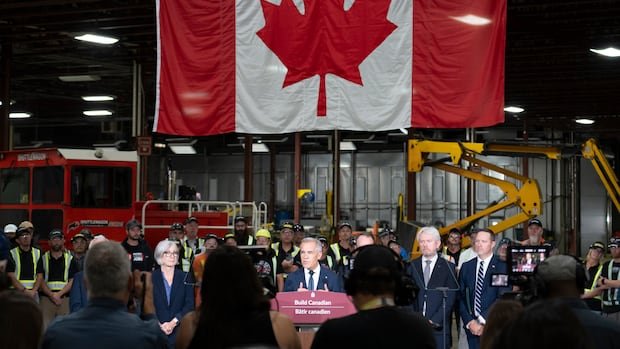

In a significant move to support the Buy Canadian Policy, the federal government has allocated over $4.7 billion for Via Rail to procure and maintain 313 new passenger rail cars from Alstom Canada. This marks the first time in forty years that Via Rail will have its passenger cars entirely manufactured in Canada, as most of its existing fleet was constructed in the United States.
During the announcement at the Alstom Plant in Thunder Bay, Ont., Prime Minister Mark Carney emphasized the involvement of Canadian workers in the project, from electricians to machinists and welders. The manufacturing and assembly of the cars will take place in Thunder Bay and La Pocatière, Que., with design and engineering work based in Saint-Bruno-de-Montarville, Que.
The government estimates that this initiative could inject over $1.6 billion into the economy and sustain nearly 700 jobs in Ontario and Quebec. Michael Keroullé, President and CEO of Alstom Americas, hailed this contract as a pivotal moment, emphasizing the necessity of replacing the aging 70-year-old cars.
Furthermore, the project aligns with another significant endeavor at the plant, where final assembly work for new subway cars for the Toronto Transit Commission is underway, incorporating 55% Canadian content. The timeline for the construction of the Via Rail cars is yet to be determined.
Describing the announcement as a substantial investment in critical infrastructure, Mathieu Paquette, interim CEO of Via Rail Canada, highlighted the essential role of rail services as a lifeline for many Canadians. The new fleet will feature various sleeper cars and panorama dome cars, promising a renewed and enhanced experience for passengers.
For the employees at the Alstom Plant in Thunder Bay, including those represented by Unifor Local 1075, the contract signifies job security after a period of uncertainty. Justin Roberts, President of Unifor Local 1075, expressed relief and optimism, stating that the stability brought by this contract will allow workers to make long-term financial decisions without fear of job insecurity.
Local organizations, such as the Thunder Bay Community Economic Development Commission and Northwestern Ontario Municipal Association, lauded the contract, emphasizing the positive impact on the community and economy. Charla Robinson, President of the Thunder Bay Chamber of Commerce, highlighted the collaborative effort that led to this achievement, underscoring the role of such investments in fostering a stronger Canada and local community.
Despite ongoing tensions between Canada and the U.S., these investments are seen as crucial steps towards building a resilient and prosperous community. Robinson emphasized that such actions will not only create job opportunities and enhance the manufacturing sector but also provide training prospects for the community for years to come.