
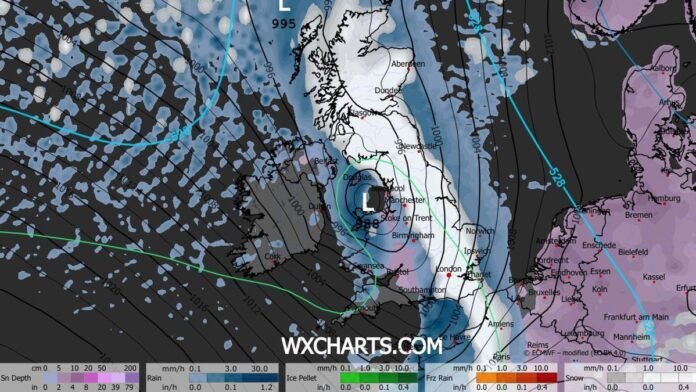

The menacing Troll of Trondheim, a snowstorm that struck the UK in 2022, is predicted to make a comeback this week, blanketing parts of Britain under snow.
An unusual polar vortex shift has triggered a massive snow front heading directly towards the UK, spanning the entire North Sea. The snow front was expected to reach its peak on Friday morning, stretching from Amsterdam in the Netherlands to the northern tip of Scotland, covering a distance of about 540 miles.
Predictions indicated up to five inches of snowfall in northern Scotland and slightly less in the North East of England, as stated by senior meteorologist Jim Dale from British Weather Services. Dale mentioned that the snow was anticipated to shift southwards during the week, possibly reaching Dorset.
The disruption of the polar vortex, a spinning system around the Arctic, is causing this event. The dislocation of the vortex due to stratospheric warming above the pole influences the movement of the spinning system in different directions.
Besides the UK, other parts of northern Europe, and even mid-Europe, are also expected to experience the cold air. The Arctic air is set to extend across Scandinavia, potentially resembling the previous Troll from Trondheim snowstorm, with the extent of its impact yet to be determined.
The Troll of Trondheim, a significant snow event at the end of 2022, brought nearly five inches of snow to the highlands of Scotland and affected most parts of the country, accompanied by temperatures dropping to -7C and warnings for ice and freezing fog.
Snowfall was expected to commence in Scotland on New Year’s Day, extending to Norfolk by January 4 and even reaching central Wales. Forecasts indicated heavy snowfalls in Scotland followed by the North East, gradually moving south to areas like Dartmoor and the Black Mountains in Wales.
Initial weather maps showed Arctic snow hitting Scotland on New Year’s Eve, with the snowfall spreading across the North Sea by the end of New Year’s Day. The Met Office issued a yellow weather warning for snow and ice in northern Scotland from 6 am on New Year’s Day until the end of Friday, January 2, with forecasts suggesting snow to become more widespread across the UK.
Deputy chief forecaster Mark Sidaway from the Met Office warned of cold conditions, strong northerly winds, severe frosts, and the first snow of the winter affecting many parts of the UK, lasting through at least the first week of January. Sidaway advised the public to stay updated with the latest weather forecasts and alerts during this cold spell.