
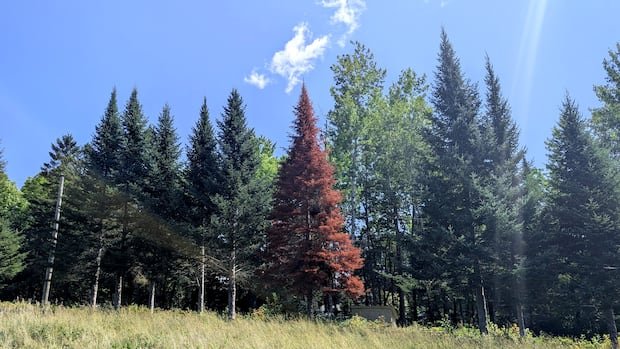

Balsam fir trees in New Brunswick are displaying red foliage and experiencing mortality due to the drought that occurred last summer, sparking concerns about the fate of this iconic provincial tree. Forestry researcher Prof. Anthony Taylor from the University of New Brunswick has been receiving reports from woodlot owners and witnessing the adverse effects firsthand as the vibrant evergreens, commonly used as Christmas trees, gradually transition to a red, desiccated state before perishing.
According to Prof. Taylor, the current situation aligns with his observations from previous hot and dry summers, indicating that the balsam fir’s growth is significantly hampered by warm and arid conditions. He has extensively studied the impact of climate change on New Brunswick’s forests and noted similar die-offs of balsam firs following exceptionally hot and dry summers in 1986 and 2018.
In response to drought stress, the balsam fir trees prematurely halt the photosynthesis process, impeding growth and energy production essential for sustaining basic metabolic functions and defense mechanisms. This compromised state leaves the trees vulnerable to additional stressors like insects or diseases, further escalating the chances of mortality, as explained by Prof. Taylor.
The shallow root system of these trees exacerbates the challenge of accessing water during dry periods. Woodlot owner Peter McKeil observed initial signs of damage to his balsam firs in June, noting a progressive red discoloration from the lower branches upwards and a continuous emergence of red patches, indicating an ongoing die-off. Despite salvaging some trees for lumber, McKeil has adjusted his harvesting methods to maximize the remaining fir’s value before further losses occur.
Expressing concern about the worsening impact of climate change, McKeil opines that the balsam fir species, particularly in southern New Brunswick, faces an uncertain future and may eventually vanish or adapt to new environmental conditions. Prof. Taylor views the current scenario of red trees as a visible indicator of climate change’s detrimental effects on New Brunswick’s emblematic tree, emphasizing the urgent need for sustainable environmental practices and climate action to mitigate these consequences.