
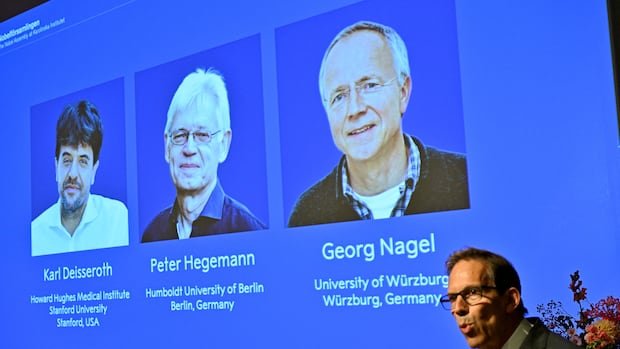

Karl Deisseroth, Peter Hegemann, and Georg Nagel have been awarded the 2026 Nobel Prize in Physiology or Medicine for their groundbreaking work on light-gated ion channels and optogenetics, as announced by the Nobel Assembly at Karolinska Institutet in Stockholm. Optogenetics enables the precise control of individual nerve cell activity in living brains, unveiling previously unknown aspects of brain function on a global scale.
The trio, consisting of American Deisseroth, and Germans Hegemann and Nagel, expressed their mutual surprise and gratitude for sharing the prestigious award. They will divide the prize money of 12 million Swedish crowns ($1.7 million Cdn) among themselves. Deisseroth is affiliated with Stanford University in California, while Hegemann works at Humboldt University in Berlin, and Nagel is based at the University of Würzburg in Germany.
Anna Wedell, a geneticist and Nobel committee member, highlighted the significance of optogenetics in advancing neuroscience, emphasizing its role in unraveling the brain’s information processing mechanisms and neuronal interactions.
In ongoing clinical trials, optogenetics shows promising applications in restoring vision to individuals affected by retinitis pigmentosa, a condition causing blindness. The technique also holds potential for enhancing cochlear implants by offering more precise stimulation of the auditory nerve compared to existing electrical devices.
The roots of optogenetics trace back to the early 1990s when Hegemann’s research on the alga Chlamydomonas led to the discovery of channelrhodopsin-2, an ion channel activated by light. Subsequent collaborations and discoveries culminated in the development of optogenetics as a tool for manipulating cellular activity using light, revolutionizing neuroscience research.
The Nobel Prizes in Chemistry and Physics are scheduled for announcement in the following days, with literature and peace prizes to follow. The economics prize winner will be revealed on October 12. The Nobel Prize, established by Alfred Nobel, a Swedish chemist and entrepreneur, aims to honor individuals who have made significant contributions benefiting humanity. Nobel, known for his invention of dynamite, left a legacy that continues to recognize remarkable achievements across various fields, symbolizing his enduring impact on society.