
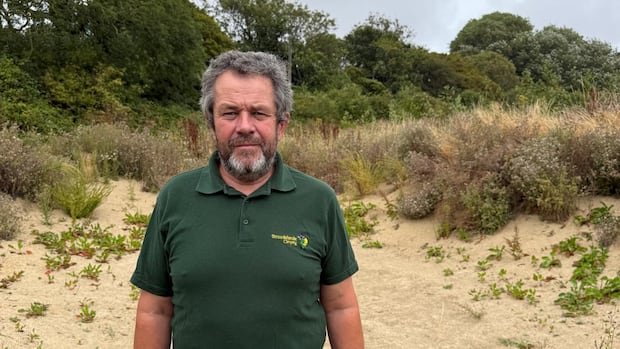

In a field on his farm in southern England, James Baird indicated deep cracks in the ground, emphasizing the severity of the situation. Baird, a crop farmer in West Sussex known for his environmentally friendly practices, expressed astonishment at the unusual conditions this summer. Unlike any he has experienced in his 40 years of farming, this year’s cereal harvest at Stroodelande farm finished much earlier than usual, with crop yields plummeting by 25 percent.
The prevailing perception of the U.K. as a rainy place has been challenged by the recent series of droughts over the past five years, leading to noticeable patterns, Baird noted. This summer stands out as the driest he has ever encountered, transforming the typically lush countryside into a parched landscape due to consecutive heatwaves and prolonged dry spells.
As per the United Kingdom’s Environment Agency, half of England and all of Wales are now officially in a state of drought following an exceptionally serious dry spell. The country received only seven percent of its average July rainfall, with southern England experiencing a mere one percent, equivalent to a minimal 0.7 millimeters of rainfall.
The ongoing drought is not only impacting traditional English ways of life but is also raising concerns about the nation’s long-term water security. Projections suggest that by 2050, England could face a water supply deficit of five billion liters daily. This situation has sparked fears of potential food shortages, as highlighted by the National Farmers’ Union.
The prolonged heatwave has devastated crops, led to shrinking water bodies, and fueled numerous wildfires across the region. With over 20 million people under hosepipe bans, the severity of the situation has become evident, prompting individuals to rethink their farming methods and adapt to the changing climate conditions.
Farmers like Baird, Christensen, and Gilbert are exploring various strategies to cope with the challenges. Measures include enhancing soil moisture retention through organic matter, shifting crop choices for better resilience, and implementing new disease control measures for livestock, as seen on Christensen’s farm in Oxford.
Moreover, the impact of the drought extends beyond agriculture, affecting inland waterways and canal-based communities. Low water levels have led to closures and disruptions, posing challenges to individuals like Bownass and Griffin, who rely on water transport for their livelihoods.
As the U.K. grapples with these extreme weather events and their repercussions, individuals across various sectors are adjusting to the changing landscape, embracing resilience as a key strategy for navigating the uncertain times ahead.