
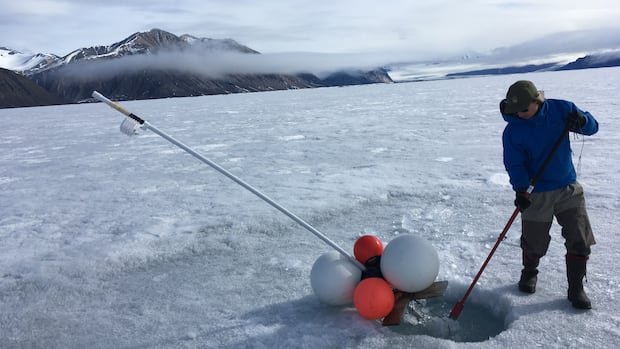

Canada’s sole remaining epishelf lake, characterized by freshwater atop saltwater, has vanished, along with the distinct ecosystem it sustained, according to a recent study by scientists. Jérémie Bonneau, the study’s lead author and an assistant professor at Laval University in Quebec City, expressed sorrow over the loss, stating that the Milne Fiord epishelf lake on Ellesmere Island in Nunavut was a unique feature in Canada that has now disappeared.
The complete disappearance of this once common phenomenon illustrates how a warming climate is reshaping the Arctic. While the demise of the lake had been previously reported, the new study, recently published in the journal Scientific Reports, delves into the process of its disappearance, highlighting the irreversible loss that signifies a significant shift and the conclusion of a 4000-year era.
The formation of epishelf lakes involves glaciers acting as icy rivers that usually flow into the sea, carrying meltwater with them. However, in the case of the Milne Fiord, the mouth of the fiord had been blocked for millennia by the Milne Ice Shelf, creating a unique environment where freshwater accumulated on top of the Arctic Ocean’s saltwater due to the freshwater’s lower density.
This epishelf lake had a layer of ice covering it year-round, shielding the freshwater and saltwater layers from mixing and making the lake hidden from the surface. The lake’s existence, dating back over 4,000 years, was characterized by an 18-meter-deep freshwater layer in 1983, akin to the height of a six-story building.
The research revealed distinct ecosystems in the freshwater and saltwater layers of the lake, with minimal overlap between the communities residing just 20 centimeters apart. The lake supported a variety of organisms, including bacteria, viruses, and phytoplankton, some of which were previously unreported in the Arctic.
Following the collapse of the Milne Ice Shelf in 2020, the epishelf lake lost its containment and rapidly drained away, leading to the demise of its inhabitants as freshwater mixed with seawater. While epishelf lakes are now absent in Canada, a few still exist in Greenland and Antarctica, though their future remains uncertain due to environmental changes.
The loss of Canada’s last epishelf lake underscores the irreplaceable nature of these ecosystems and highlights the ongoing impact of climate change on the Arctic environment.